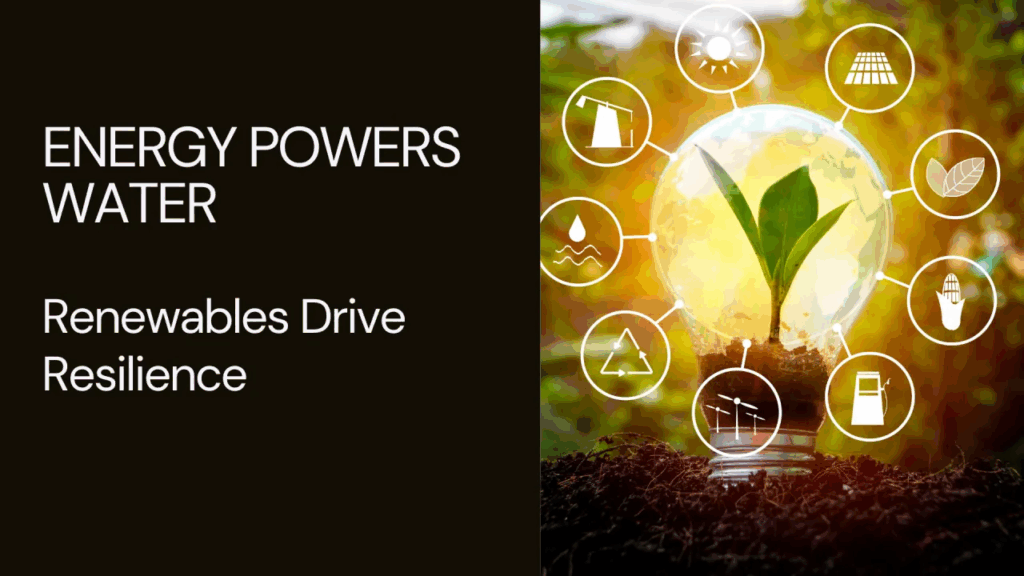
Welcome to this week’s edition of the “Our Future Water” newsletter. In this issue, we explore how renewable energy is transforming water and wastewater treatment plants. As global energy and water demands rise, integrating clean energy solutions such as biogas, solar, and wind into treatment operations is key to reducing greenhouse gas emissions, conserving natural resources, and building climate-resilient water infrastructure.
Insights
Wastewater Treatment Plants and Renewable Energy
Wastewater treatment plants are essential for protecting public health and the environment but are also energy-intensive. To reduce their environmental footprint, many facilities are turning to renewable energy sources like solar, wind, and biogas to power their operations. Using renewable energy, wastewater treatment plants can cut emissions, lower operational costs, and contribute to broader climate goals.
Biogas, produced from the organic matter in wastewater, is one of the most promising energy sources for treatment plants. Through anaerobic digestion, wastewater treatment plants can generate renewable energy, turning waste into power while reducing methane emissions. These facilities also incorporate solar panels and wind turbines to offset their energy demands.
Read the full article by Robert C. Brears to discover how Melbourne Water’s biogas initiatives drive renewable energy production. At the Western and Eastern Treatment Plants, biogas from sewage treatment is captured and converted into electricity, meeting 80% of the plant’s energy needs and reducing greenhouse gas emissions. With a second power station at the Western Plant, Melbourne Water will exceed its energy requirements and contribute to its net-zero emissions goal by 2030.
Water Treatment Plants and Renewable Energy
Water treatment plants provide communities with clean, safe drinking water. However, these plants require significant energy for filtration, disinfection, and distribution. Renewable energy offers an opportunity to make water treatment more sustainable. By utilising solar power, wind energy, and other renewables, water treatment plants can minimize their reliance on fossil fuels and reduce greenhouse gas emissions.
Many water treatment plants install solar panels or wind turbines on-site to generate power directly. Additionally, some facilities are exploring energy recovery systems that harness water flow to generate electricity. These innovations are helping water utilities meet their energy needs in a more sustainable way while maintaining reliable water supplies.
Read the full article by Robert C. Brears to explore how Hamburg Wasser is harnessing renewable energy to power its water treatment facilities. The company generates over 12 million kWh of electricity annually through investments in solar and wind power, significantly reducing its reliance on non-renewable sources. These initiatives lower greenhouse gas emissions and contribute to cost savings, making renewable energy a central pillar of Hamburg Wasser’s sustainable operations.
Stay Connected & Gain Exclusive Water Insights
🔹 Want in-depth Middle East water insights? 👉 Subscribe to the Middle East Water Tech Brief for exclusive analysis on desalination, AI innovations, mega-projects, and climate-resilient water investments.
🔹 Join the movement! 🌍 Become a member of the Our Future Water Network and connect with global water leaders shaping the future.
🔹 Join the conversation in the following LinkedIn groups:
Urban Water Security, Our Future Water, Circular Water Economy, Blue-Green Infrastructure, Nature-Based Solutions, Climate Resilient Water Resources Management, Water Governance, Global Climate Solutions, Nature-Based Water Management
Explore the Full Book Collection on Green Economy & Innovation Pathways
Accelerate the shift to a low-carbon, inclusive future with expert insights from Our Future Water and Global Climate Solutions. This collection highlights the tools, technologies, and strategies driving resilient and sustainable economic transformation.
⚡ Policy frameworks for enabling sustainable, equitable growth
🔬 Innovations in clean technologies and future-focused business models
📘 Pathways for long-term systems change, resilience, and impact
Click here to explore the complete collection.
Shape the Future of Sustainability: Contribute to Springer Nature’s Landmark Publications
As Editor-in-Chief, Robert C. Brears invites experts, researchers, and practitioners to contribute to impactful and forward-thinking publications from Springer Nature. These comprehensive Handbooks and Encyclopedias explore Nature-Based Solutions, sustainable resource management, ecosystem well-being, and the global energy transition.
- Palgrave Handbook of Nature-Based Solutions
- Palgrave Encyclopedia of Sustainable Resources and Ecosystem Resilience
- Palgrave Handbook of Ecosystems and Human Well-Being
- Palgrave Handbook of Energy Transition and Renewable Energy
- Palgrave Handbook of Urban Climate and Disaster Resilience
- Palgrave Handbook of Social Transformations in Science, Innovation, and Education
Shape the Future of Climate Resilience: Contribute to Palgrave’s Pivot Series
As Series Editor, Robert C. Brears invites experts to contribute to Palgrave Studies in Climate Resilient Societies, a leading Pivot series (25,000–50,000 words) exploring climate resilience, policy innovation, and sustainability strategies.
📩 For more details, visit: Seeking Authors — Palgrave Studies in Climate Resilient Societies