Welcome to this week’s edition of the “Our Future Water” newsletter.
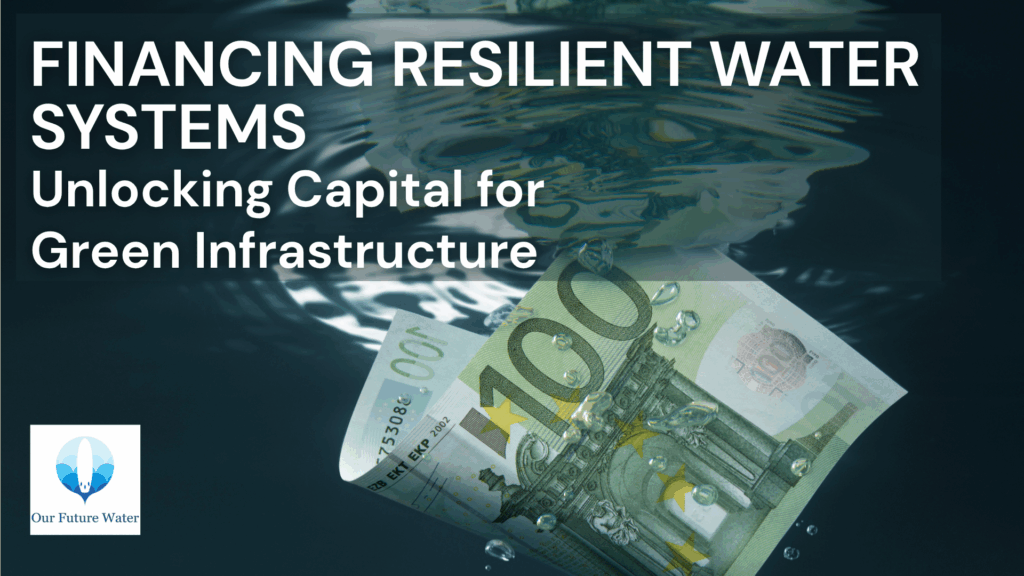
This issue explores how innovative financing models are reshaping the future of water management and green infrastructure. We spotlight how Environmental Impact Bonds (EIBs) are enabling cities to invest in resilient, sustainable solutions and examine the broader funding landscape, focusing on mechanisms that bridge critical gaps for water resources management. Together, these approaches underscore the transformative power of finance to drive progress in climate resilience and sustainable water systems.
Insights
Environmental Impact Bonds: Financing Green Infrastructure for Urban Resilience
EIBs are emerging as a game-changing tool to fund green infrastructure projects. By tying returns to environmental outcomes, EIBs attract private capital and share performance risks and benefits between investors and utilities. This results-driven approach not only mobilizes new investment but also ensures that projects deliver measurable environmental benefits, such as reduced stormwater runoff and improved urban resilience.
Cities facing ageing infrastructure and growing climate risks are increasingly turning to EIBs to finance nature-based solutions, such as permeable pavements, rain gardens, and green roofs. These investments help manage water sustainably, reduce flood risks, and create greener, healthier urban environments for communities.
Read the full article by Robert C. Brears to discover how the District of Columbia Water and Sewer Authority (DC Water) implemented the United States’ first EIB as part of its Clean Rivers Project. The $25 million bond financed green infrastructure to reduce runoff into Rock Creek, with performance-based payments linked to actual reductions in stormwater. This innovative approach demonstrated how outcome-driven finance can drive progress on water resilience while aligning the interests of utilities, investors, and the public.
Financing Water Resources Management: Bridging the Funding Gap
Securing sustainable water resources requires more than technical solutions — it demands robust, innovative financing. Traditional funding streams often fall short, leaving critical gaps in infrastructure, technology, and management practices that are necessary to ensure safe and reliable water for people and ecosystems. Addressing these challenges means rethinking how projects are funded and leveraging new financial instruments.
Innovative mechanisms, such as blended finance, green bonds, and payments for ecosystem services (PES), are being increasingly utilized to attract private investment and incentivize sustainable practices. These tools enable the scaling of water solutions, improve efficiency, and help cities and regions adapt to water scarcity, pollution, and the impacts of climate change.
Read the full article by Robert C. Brears to learn how New York City uses a PES scheme to protect its vast drinking water supply. By partnering with landowners and funding best management practices, the city safeguards water quality for millions while promoting ecosystem stewardship. This approach demonstrates how effective financing can deliver lasting benefits for both people and the environment.
Key Takeaways
Innovative finance is at the heart of building resilient water systems and scaling green infrastructure. By adopting outcome-based tools like EIBs and leveraging blended finance and PES schemes, cities and regions can close funding gaps, foster cross-sectoral partnerships, and ensure long-term water security for both communities and ecosystems.
Stay Connected & Gain Exclusive Water Insights
🔹 Want in-depth Middle East water insights? 👉 Subscribe to the Middle East Water Tech Brief for exclusive analysis on desalination, AI innovations, mega-projects, and climate-resilient water investments.
🔹 Join the movement! 🌍 Become a member of the Our Future Water Network and connect with global water leaders shaping the future.
🔹 Join the conversation in the following LinkedIn groups:
Urban Water Security, Our Future Water, Circular Water Economy, Blue-Green Infrastructure, Nature-Based Solutions, Climate Resilient Water Resources Management, Water Governance, Global Climate Solutions, Nature-Based Water Management
📚 New Book Titles on Financing Water, Green Infrastructure & Resilient Solutions
📚 Financing Green Infrastructure: Innovative Strategies for Sustainable Urban Water Management and Climate Resilience
📚 Climate Finance: A Comprehensive Guide to Funding Climate Change Mitigation and Adaptation Projects
📚 Debt-for-Water Swaps: Innovative Finance for Water Security, Climate Resilience, and Sustainable Development
📚 Explore the Full Book Collection on Climate Finance & Sustainability
Drive meaningful change with practical insights from Our Future Water and Global Climate Solutions. This curated collection equips professionals with the tools to navigate today’s evolving landscape of green finance and ESG-aligned investments.
📘 In-depth guides on sustainable finance, policy design, and governance
🔍 Scalable frameworks for climate action and resource efficiency
🌎 Targeted insights for decision-makers, investors, and sustainability advisors
Click here to explore the complete collection.
📚 Shape the Future of Sustainability: Contribute to Springer Nature’s Landmark Publications
As Editor-in-Chief, Robert C. Brears invites experts, researchers, and practitioners to contribute to impactful and forward-thinking publications from Springer Nature. These comprehensive Handbooks and Encyclopedias explore Nature-Based Solutions, sustainable resource management, ecosystem well-being, and the global energy transition.
- Palgrave Handbook of Nature-Based Solutions
- Palgrave Encyclopedia of Sustainable Resources and Ecosystem Resilience
- Palgrave Handbook of Ecosystems and Human Well-Being
- Palgrave Handbook of Energy Transition and Renewable Energy
- Palgrave Handbook of Urban Climate and Disaster Resilience
- Palgrave Handbook of Social Transformations in Science, Innovation, and Education
📚 Shape the Future of Climate Resilience: Contribute to Palgrave’s Pivot Series
As Series Editor, Robert C. Brears invites experts to contribute to Palgrave Studies in Climate Resilient Societies, a leading Pivot series (25,000–50,000 words) exploring climate resilience, policy innovation, and sustainability strategies.
📩 For more details, visit: Seeking Authors — Palgrave Studies in Climate Resilient Societies