Welcome to this week’s edition of the “Our Future Water” newsletter.
This issue explores how restoring natural systems within cities is reshaping urban resilience, public health, and environmental performance. From urban wetlands that regulate climate and support biodiversity to multifunctional green infrastructure parks that manage stormwater and enhance liveability, these approaches show how nature-based solutions are redefining sustainable urban design.
Insights
Urban Wetlands and Ecosystem Restoration: Reviving Nature in the City
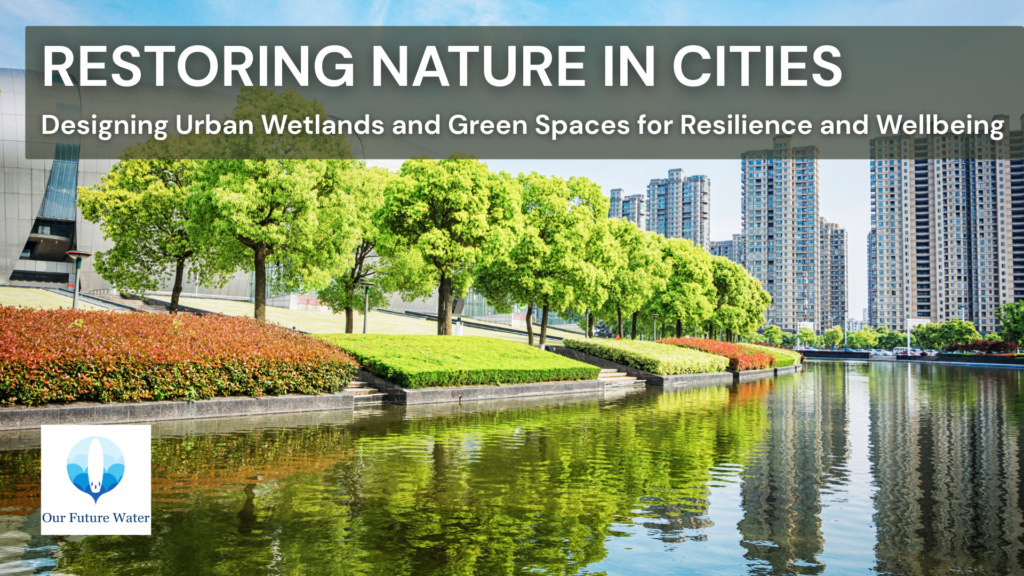
As cities expand, integrating natural ecosystems into urban environments is becoming essential for resilience and quality of life. Urban wetlands play a critical role in biodiversity conservation, climate regulation, flood mitigation, and community well-being. By absorbing excess water, filtering pollutants, and moderating temperatures, wetlands provide vital ecosystem services that conventional grey infrastructure cannot replicate.
Beyond their environmental functions, urban wetlands deliver tangible social and health benefits. They improve air and water quality, reduce urban heat island effects, and create restorative spaces that support mental and physical health. As climate change intensifies rainfall and heat extremes, wetlands are increasingly recognized as cost-effective and adaptive solutions within dense urban landscapes.
Read the full article by Robert C. Brears to learn how the restoration of the Cheonggyecheon Stream in Seoul transformed a former elevated highway into a thriving urban wetland. The project has enhanced biodiversity, reduced local temperatures, lowered flood risk, and created a central public space that has dramatically improved environmental quality and liveability in the heart of the city.
Green Infrastructure Parks: Designing Multifunctional Urban Spaces
Green infrastructure parks are redefining the role of public spaces in cities by combining recreation with essential environmental functions. These parks integrate natural systems such as rain gardens, bioswales, permeable pavements, wetlands, and green roofs to manage stormwater, improve water quality, and enhance urban resilience. Rather than serving a single purpose, green infrastructure parks deliver multiple co-benefits across water management, climate adaptation, and public health.
In addition to reducing flooding and infrastructure stress, these parks contribute to healthier communities. Access to green spaces supports physical activity, reduces stress, and improves overall well-being. Economically, green infrastructure parks can increase property values, attract investment, and reduce long-term maintenance costs compared to traditional infrastructure solutions.
Read the full article by Robert C. Brears to explore how Millennium Park in Chicago exemplifies green infrastructure park design. By integrating stormwater management, energy-efficient systems, and inclusive public amenities, Millennium Park demonstrates how cities can deliver environmental performance, economic value, and vibrant public life through sustainable urban design.
Key Takeaways
Urban wetlands restoration and green infrastructure parks highlight the growing role of nature-based solutions in building resilient, healthy, and liveable cities. By embedding ecological systems into urban planning, cities can manage water more effectively, adapt to climate risks, and enhance quality of life while delivering long-term economic and environmental benefits.
Newly Published: Circular Economy and Liveable Cities (Cambridge University Press)
The Circular Economy and Liveable Cities, edited by Robert C. Brears, Our Future Water, has been published. This essential guide delivers actionable strategies and best practices for implementing circular economy, climate resilience, and sustainability in urban environments, with global examples from leading cities like Tokyo, New York, and Singapore to help planners, policymakers, and researchers build liveable and sustainable cities for the future.
Out Now: 2nd Edition of Nature-Based Solutions to 21st Century Challenges (Routledge)
Fully revised and updated, the second edition of Nature-Based Solutions to 21st Century Challenges by Robert C. Brears offers a timely and systematic review of how working with nature can address today’s most pressing environmental and societal issues. Featuring new case studies from across the globe, expanded insights on public policy, AI, and community-led initiatives, this edition is essential reading for anyone shaping a sustainable future.
Stay Connected & Gain Exclusive Water Insights
🔹 Stay ahead in water innovation! 👉 Sign up for Our Future Water’s LinkedIn newsletter for expert insights and industry trends.
🔹 Want in-depth Middle East water insights? 👉 Subscribe to the Middle East Water Tech Brief for exclusive analysis on desalination, AI innovations, mega-projects, and climate-resilient water investments.
🔹 Join the conversation in the following LinkedIn groups:
Urban Water Security, Our Future Water, Circular Water Economy, Blue-Green Infrastructure, Nature-Based Solutions, Climate Resilient Water Resources Management, Water Governance, Global Climate Solutions,Nature-Based Water Management
📚 Shape the Future of Sustainability: Contribute to Springer Nature’s Landmark Publications
As Editor-in-Chief, Robert C. Brears invites experts, researchers, and practitioners to contribute to impactful and forward-thinking publications from Springer Nature. These comprehensive Handbooks and Encyclopedias explore Nature-Based Solutions, sustainable resource management, ecosystem well-being, and the global energy transition.
- Palgrave Handbook of Nature-Based Solutions
- Palgrave Encyclopedia of Sustainable Resources and Ecosystem Resilience
- Palgrave Handbook of Ecosystems and Human Well-Being
- Palgrave Handbook of Energy Transition and Renewable Energy
- Palgrave Handbook of Urban Climate and Disaster Resilience
- Palgrave Handbook of Social Transformations in Science, Innovation, and Education
📚 Shape the Future of Climate Resilience: Contribute to Palgrave’s Pivot Series
As Series Editor, Robert C. Brears invites experts to contribute to Palgrave Studies in Climate Resilient Societies, a leading Pivot series (25,000–50,000 words) exploring climate resilience, policy innovation, and sustainability strategies.
📩 For more details, visit: Seeking Authors — Palgrave Studies in Climate Resilient Societies
📚 Explore the Full Book Collection on Green Infrastructure Strategies
Advance urban resilience with practical guidance from Our Future Water and Global Climate Solutions. This essential collection offers proven approaches for designing, implementing, and maintaining multifunctional green infrastructure systems.
🌿 Frameworks for integrating nature into urban environments
🏙️ Strategies for aligning ecological design with planning and policy priorities
🔧 Tools to support long-term performance and adaptive maintenance
Click here to explore the complete collection.