Welcome to this week’s edition of the “Our Future Water” newsletter. Urban resilience depends on how cities manage the relationship between built environments and natural systems that regulate water, climate, biodiversity, and public health. Nature-based and socio-technical systems increasingly function as essential infrastructure assets that help cities reduce risk while improving long-term livability. This edition explores how green infrastructure and groundwater replenishment can strengthen urban water security, climate resilience, and ecosystem performance.
Insights
Green Infrastructure as Urban Resilience Infrastructure
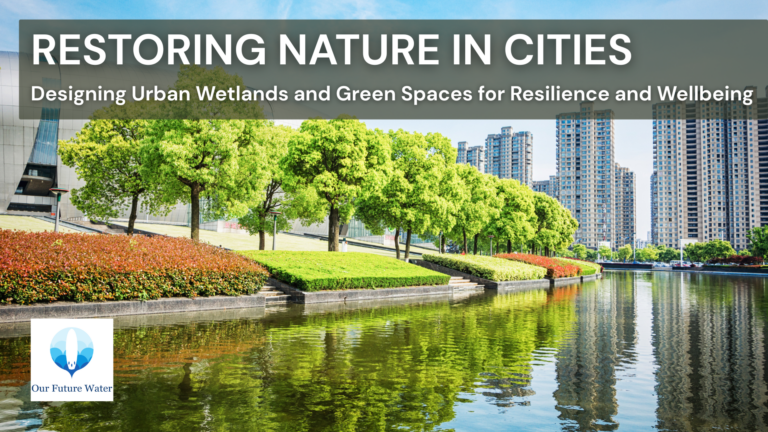
Green infrastructure refers to networks of parks, trees, wetlands, green roofs, rain gardens, and other natural or semi-natural systems integrated into urban environments. These systems function as water and climate infrastructure by supporting stormwater retention, filtration, infiltration, and evapotranspiration. They also reduce runoff volumes, moderate urban temperatures, improve air quality, and create more permeable landscapes that support water management within densely built areas. In governance terms, green infrastructure enables cities to align land-use, biodiversity protection, and water-management objectives within a single planning framework.
Beyond their operational role in water management, green infrastructure systems generate benefits across biodiversity, climate regulation, public health, and social resilience. Urban vegetation and restored habitats support ecosystem integrity by creating wildlife corridors and improving habitat connectivity. Access to green space also contributes to mental and physical well-being by reducing stress, encouraging recreation, and strengthening social interaction. These outcomes improve long-term resilience because healthier ecosystems and healthier communities are better able to absorb environmental, climatic, and social shocks.
Plan Melbourne 2017–2050 illustrates how green infrastructure can be embedded in long-term urban planning. The framework expands the urban forest, develops parks and green spaces, incorporates wetlands and rain gardens for stormwater management, and establishes wildlife corridors across the urban landscape. These measures support reduced urban heat, improved water quality, lower flood risk, and stronger biodiversity outcomes. Read the full article by Robert C. Brears to learn how integrated urban greening strategies can align water management, biodiversity protection, and public well-being within a single planning framework.
Groundwater Replenishment as Water Security Infrastructure
Groundwater replenishment is the intentional recharge of underground aquifers using captured stormwater, runoff, or other water sources. It functions as a critical water management system by increasing groundwater storage, reducing pressure on imported supplies, and improving the reliability of local water resources. Core mechanisms include stormwater capture, infiltration through spreading grounds, natural filtration through soils, and controlled recharge using engineered structures. These systems also reduce flood risk by diverting runoff away from overloaded drainage networks and into underground storage systems.
The benefits of groundwater replenishment extend beyond water supply. By reducing surface runoff and supporting aquifer recharge, these systems contribute to flood resilience and improve ecosystem stability in water-stressed urban areas. Natural filtration processes improve water quality by removing pollutants as water moves through soil layers, which benefits public health, aquatic ecosystems, and long-term resource sustainability. Groundwater replenishment also enhances economic stability by reducing vulnerability to drought, supply disruptions, and the rising costs associated with imported water.
The Los Angeles Groundwater Replenishment Project in Los Angeles County, United States, demonstrates how recharge infrastructure can strengthen urban water resilience. The county uses spreading grounds, stormwater reservoirs, rubber dams, and seawater barrier systems with injection wells to replenish aquifers and protect freshwater supplies. These measures improve groundwater storage, reduce flood risk, and prevent seawater intrusion into freshwater aquifers. Read the full article by Robert C. Brears to learn how groundwater recharge systems can combine flood management, water supply diversification, and water quality protection in urban areas.
Key Takeaways
Green infrastructure and groundwater replenishment systems show how cities can treat natural and hybrid infrastructure as core components of water governance and urban planning. Integrating ecosystem functions with engineered systems improves water security, reduces flood risk, supports biodiversity, and strengthens public well-being. Coordinated planning across these systems delivers stronger resilience and more sustainable urban outcomes.
Circular Economy and Liveable Cities (Cambridge University Press)
The Circular Economy and Liveable Cities, edited by Robert C. Brears, Our Future Water, has been published. This essential guide delivers actionable strategies and best practices for implementing circular economy, climate resilience, and sustainability in urban environments, with global examples from leading cities like Tokyo, New York, and Singapore to help planners, policymakers, and researchers build liveable and sustainable cities for the future.
2nd Edition of Nature-Based Solutions to 21st Century Challenges (Routledge)
Fully revised and updated, the second edition of Nature-Based Solutions to 21st Century Challenges by Robert C. Brears offers a timely and systematic review of how working with nature can address today’s most pressing environmental and societal issues. Featuring new case studies from across the globe, expanded insights on public policy, AI, and community-led initiatives, this edition is essential reading for anyone shaping a sustainable future.
Water Intelligence Brief
Water Intelligence Brief delivers global intelligence on water policy, infrastructure investment, desalination, digital water, and climate resilience across MENA, Europe, Asia, India, and the USA.
Each issue combines:
- Major policy developments
- Infrastructure investment signals
- Technology and digital water trends
- Utility and regulatory developments
- Climate resilience and adaptation strategies
- Market outlooks and strategic analysis
Regional Editions
- MENA · Monthly
- Europe · Monthly
- Asia · Quarterly
- India · Quarterly
- USA · Quarterly
Explore the latest intelligence and subscribe at waterintelligencebrief.com
Stay Connected & Gain Exclusive Water Insights
🔹 Stay ahead in water innovation! 👉 Sign up for Our Future Water’s LinkedIn newsletter for expert insights and industry trends.
🔹 Join the conversation in the following LinkedIn groups:
Urban Water Security, Our Future Water, Circular Water Economy, Blue-Green Infrastructure, Nature-Based Solutions, Climate Resilient Water Resources Management, Water Governance, Global Climate Solutions, Nature-Based Water Management
📚 Shape the Future of Sustainability: Contribute to Springer Nature’s Landmark Publications
As Editor-in-Chief, Robert C. Brears invites experts, researchers, and practitioners to contribute to impactful and forward-thinking publications from Springer Nature. These comprehensive Handbooks and Encyclopedias explore Nature-Based Solutions, sustainable resource management, ecosystem well-being, and the global energy transition.
- Palgrave Handbook of Nature-Based Solutions
- Palgrave Encyclopedia of Sustainable Resources and Ecosystem Resilience
- Palgrave Handbook of Energy Transition and Renewable Energy
- Palgrave Handbook of Urban Climate and Disaster Resilience
- Palgrave Handbook of Social Transformations in Science, Innovation, and Education
📚 Shape the Future of Climate Resilience: Contribute to Palgrave’s Pivot Series
As Series Editor, Robert C. Brears invites experts to contribute to Palgrave Studies in Climate Resilient Societies, a leading Pivot series (25,000–50,000 words) exploring climate resilience, policy innovation, and sustainability strategies.
📩 For more details, visit: Seeking Authors — Palgrave Studies in Climate Resilient Societies