Key Takeaways
- Vertical farming reduces freshwater demand through closed-loop water recirculation.
- Controlled environment agriculture improves food supply reliability under climate stress.
- Hydroponic and aeroponic systems support precise water and nutrient delivery.
- Water recycling, vapor recovery, and automation strengthen resource efficiency.
- Urban vertical farms can reduce land pressure, runoff, and external supply chain dependence.
Welcome to this week’s edition of the “Our Future Water” newsletter. Urban food systems are increasingly constrained by water scarcity, requiring production models that decouple agricultural output from intensive water use and climate variability. This shift positions controlled environment agriculture as a form of water infrastructure that integrates resource efficiency with supply reliability. Across both insights, the unifying theme is vertical farming as a socio-technical system that governs water through closed-loop control, precision delivery, and resource recirculation.
Insights
Vertical Farming Systems as Closed-Loop Water Infrastructure
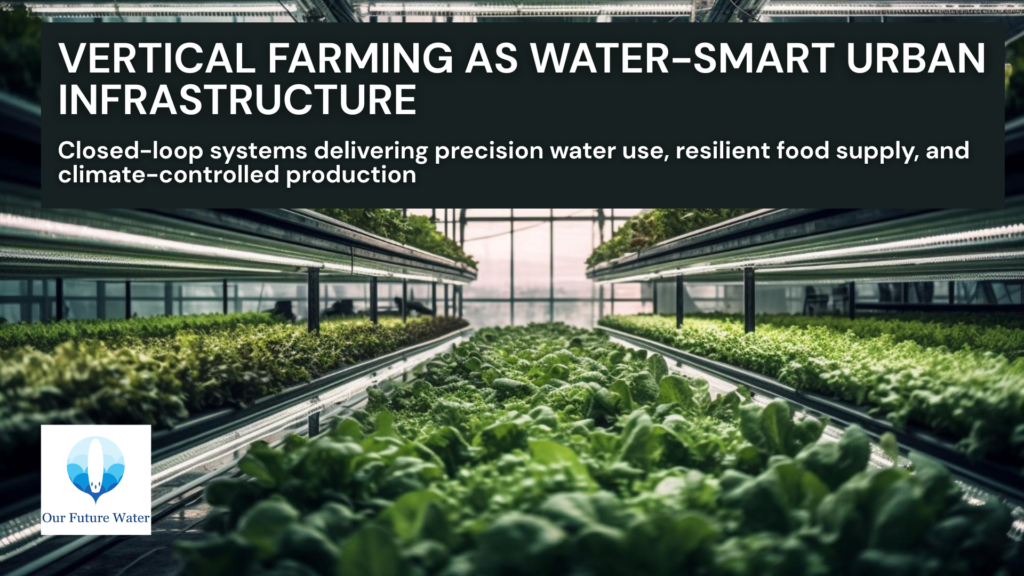
Vertical farming systems are controlled environment agricultural platforms that function as closed-loop water infrastructure within urban settings. These systems rely on hydroponic or aeroponic methods where plants are grown in nutrient-enriched water rather than soil, enabling precise water delivery and minimizing losses. Core mechanisms include recirculation, where unused water is continuously reused within the system, and controlled dosing, which aligns water and nutrient supply with plant requirements. Additional mechanisms such as vapor capture and reuse further enhance efficiency by recovering evaporated moisture and reintegrating it into the system.
Beyond water efficiency, these systems generate co-benefits across climate regulation and food system resilience. By operating indoors, they reduce exposure to climate variability, supporting consistent production and strengthening food security. Reduced reliance on pesticides and herbicides improves public health outcomes and lowers chemical runoff risks, contributing to ecosystem integrity. Their compact spatial footprint also alleviates land pressure, supporting sustainable urban development while maintaining stable agricultural output under constrained environmental conditions.
Bustanica in Dubai exemplifies this model through a large-scale vertical farm using hydroponic technology within a fully controlled environment. The system implements closed-loop water recirculation and vapor recovery, resulting in significant reductions in water demand while maintaining continuous crop production. Outcomes include enhanced water use efficiency, stable year-round supply, and minimized agricultural runoff. Read the full article by Robert C. Brears to understand how closed-loop vertical farming systems optimize water recirculation and ensure consistent food production under scarcity conditions.
Controlled Environment Agriculture as Resource Optimization Systems
Controlled environment agriculture operates as an integrated resource optimization system that aligns water, energy, and nutrient flows within a governed production environment. Vertical farming structures stack crop layers and regulate temperature, humidity, and light, enabling efficient resource allocation. Key water-related mechanisms include precision irrigation through hydroponics and system-wide recycling that minimizes waste. These systems also incorporate monitoring and automation, allowing real-time adjustments that prevent overuse and ensure optimal plant uptake, thereby embedding water governance directly into operational design.
These systems extend benefits into economic stability and climate resilience by reducing dependency on imports and insulating food production from extreme weather. Integration with renewable energy contributes to lower emissions, supporting climate mitigation goals, while efficient land use preserves natural ecosystems. Social resilience is strengthened through reliable local food supply chains that reduce vulnerability to external disruptions. Together, these co-benefits position controlled environment agriculture as a foundational component of sustainable urban infrastructure.
Pure Harvest Smart Farms in the United Arab Emirates illustrates this approach through vertically integrated farming that combines hydroponic irrigation with water recycling and renewable energy inputs. The system delivers high water savings while maintaining consistent crop yields and reducing environmental impact through efficient energy use. Outcomes include improved resource efficiency, reduced reliance on external supply chains, and enhanced production stability. Read the full article by Robert C. Brears to learn how integrated vertical farming systems combine water recycling and energy optimization to strengthen food and water security.
Key Takeaways
Closed-loop vertical farming systems and controlled environment agriculture function as complementary infrastructure that embeds water governance into food production through recirculation, precision delivery, and system optimization. When integrated into urban planning and resource management frameworks, these systems enhance overall performance by aligning water efficiency with energy and food supply objectives, ultimately strengthening resilience and advancing long-term sustainability.
Circular Economy and Liveable Cities (Cambridge University Press)
The Circular Economy and Liveable Cities, edited by Robert C. Brears, Our Future Water, has been published. This essential guide delivers actionable strategies and best practices for implementing circular economy, climate resilience, and sustainability in urban environments, with global examples from leading cities like Tokyo, New York, and Singapore to help planners, policymakers, and researchers build liveable and sustainable cities for the future.
2nd Edition of Nature-Based Solutions to 21st Century Challenges (Routledge)
Fully revised and updated, the second edition of Nature-Based Solutions to 21st Century Challenges by Robert C. Brears offers a timely and systematic review of how working with nature can address today’s most pressing environmental and societal issues. Featuring new case studies from across the globe, expanded insights on public policy, AI, and community-led initiatives, this edition is essential reading for anyone shaping a sustainable future.
Water Intelligence Brief
Delivers global intelligence on water policy, infrastructure investment, desalination, digital water, climate resilience, and sector-specific water risk across regions and water-intensive industries.
Each issue delivers:
- Policy, regulatory, and market signals
- Infrastructure, investment, and supply dynamics
- Digital water, desalination, and technology trends
- Climate resilience and sector-specific risk insights
Explore the latest intelligence and subscribe at waterintelligencebrief.com
Stay Connected & Gain Exclusive Water Insights
🔹 Stay ahead in water innovation! 👉 Sign up for Our Future Water’s LinkedIn newsletter for expert insights and industry trends.
🔹 Join the conversation in the following LinkedIn groups:
Urban Water Security, Our Future Water, Circular Water Economy, Blue-Green Infrastructure, Nature-Based Solutions, Climate Resilient Water Resources Management, Water Governance, Global Climate Solutions, Nature-Based Water Management
📚 Shape the Future of Sustainability: Contribute to Springer Nature’s Landmark Publications
As Editor-in-Chief, Robert C. Brears invites experts, researchers, and practitioners to contribute to impactful and forward-thinking publications from Springer Nature. These comprehensive Handbooks and Encyclopedias explore Nature-Based Solutions, sustainable resource management, ecosystem well-being, and the global energy transition.
- Palgrave Handbook of Nature-Based Solutions
- Palgrave Encyclopedia of Sustainable Resources and Ecosystem Resilience
- Palgrave Handbook of Energy Transition and Renewable Energy
- Palgrave Handbook of Urban Climate and Disaster Resilience
- Palgrave Handbook of Social Transformations in Science, Innovation, and Education
📚 Shape the Future of Climate Resilience: Contribute to Palgrave’s Pivot Series
As Series Editor, Robert C. Brears invites experts to contribute to Palgrave Studies in Climate Resilient Societies, a leading Pivot series (25,000–50,000 words) exploring climate resilience, policy innovation, and sustainability strategies.
📩 For more details, visit: Seeking Authors — Palgrave Studies in Climate Resilient Societies
Key Questions
How does vertical farming reduce water use?
Vertical farming reduces water use by recirculating unused water, delivering nutrients precisely, and recovering moisture within controlled growing environments.
Why is vertical farming relevant to urban water security?
It helps cities produce food with lower freshwater demand, reducing pressure on conventional water supplies while supporting local food resilience.
What is controlled environment agriculture?
Controlled environment agriculture is a production system that regulates light, temperature, humidity, water, and nutrients to optimize crop growth.
How do hydroponic systems support water efficiency?
Hydroponic systems grow crops in nutrient-enriched water and reuse much of that water, minimizing losses compared with soil-based cultivation.
What are the wider benefits of vertical farming?
Wider benefits include reduced land pressure, lower agricultural runoff, more stable food supply, and improved resilience to climate variability.
Why are Dubai and the UAE relevant examples?
They show how water-scarce regions can use advanced vertical farming systems to improve food production while reducing freshwater dependence.