Welcome to this week’s edition of the “Our Future Water” newsletter. Urban water resilience depends on how buildings, landscapes, and drainage networks manage rainfall together. Treating vegetation and engineered systems as complementary infrastructure assets connects stormwater control with environmental quality and public well-being. Green roofs and green-grey hybrid systems illustrate how integrated planning can distribute water management functions across the urban fabric.
Insights
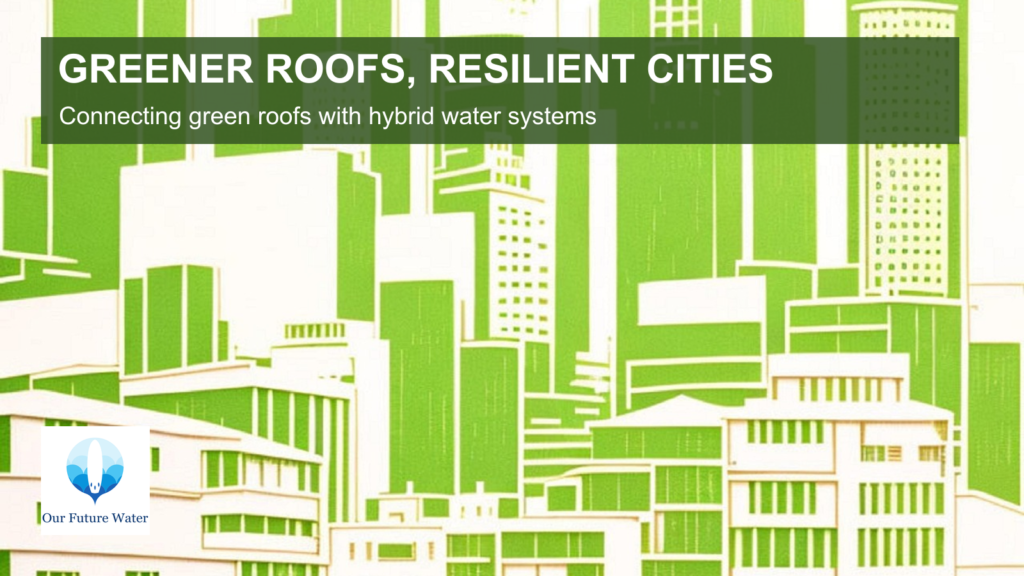
Green Roofs as Distributed Stormwater Infrastructure
Green roofs combine vegetation, growing media, drainage layers, and waterproofing to make building surfaces part of the urban water system. The growing medium retains rainfall, while drainage layers regulate the release of excess water into connected networks. Plants return moisture to the atmosphere through evapotranspiration. These mechanisms reduce and delay runoff at its source, allowing rooftops to contribute to stormwater management alongside ground-level infrastructure. Their performance depends on appropriate assembly design, plant selection, and maintenance.
Beyond runoff control, vegetated roofs can provide habitat for pollinators and birds while helping moderate building temperatures. Their insulating properties can reduce heating and cooling needs, connecting water management with energy efficiency and climate regulation. Green spaces on buildings also offer opportunities for amenity and community engagement where access and design permit. Integrating these functions into building management supports resilience to rainfall and heat while making ecoloGreen Roofs and Hybrid Systems for Urban Stormwater Resiliencegical performance part of the long-term sustainability of urban development.
Toronto, Canada, illustrates this approach through its green roof installations and supporting construction standards. Vegetated roof assemblies help retain stormwater, moderate urban heat, and reduce cooling demand. The city’s Eco-Roof Incentive Program provides a funding mechanism distinct from the construction standards governing roof design. This distinction matters because financial support encourages uptake, while technical specifications address how systems are built and maintained. Read the full article by Robert C. Brears to explore how green roof design and municipal support connect building performance with urban sustainability.
Green Grey Hybrid Systems as Integrated Water Infrastructure
Green-grey hybrid systems combine natural water processes with engineered storage, conveyance, and treatment infrastructure. Vegetation and soils intercept rainfall, encourage infiltration where conditions permit, and filter runoff. Tanks, pipes, and treatment facilities manage water that requires storage or controlled handling. Coordinating these components distributes stormwater management across a catchment while retaining the operational functions of established networks. The result is an integrated approach in which landscape design and engineering decisions shape the volume and movement of water together.
This coordination connects water quality with ecosystem integrity and community well-being. Reducing polluted discharges helps protect receiving waters, while planted spaces can provide shade, habitat, and more attractive public environments. Infrastructure investment can therefore serve drainage needs and neighborhood improvements through the same intervention. Resilience depends on matching these benefits to local conditions and maintaining both biological and engineered components. Treating the combined system as a shared planning responsibility supports reliable services and long-term environmental sustainability.
Philadelphia’s Green City, Clean Waters program in the United States illustrates this integration through green stormwater installations and improvements to conventional wastewater infrastructure. Rain gardens and planted systems intercept runoff, reducing the volume entering combined sewers and helping limit polluted overflows into waterways. Treatment capacity improvements complement these distributed measures. The program addresses regulatory water-quality obligations, while grants and incentives support participation by property owners. Read the full article by Robert C. Brears to understand how natural processes and engineered assets work together to manage urban stormwater.
Key Takeaways
Green roofs and green-grey hybrid systems make rainfall management a shared function of buildings, landscapes, and drainage networks. Integrated planning and clear maintenance responsibilities help these assets improve system performance while supporting habitat, energy efficiency, and healthier urban environments. Their combined value lies in strengthening resilience and long-term sustainability.