Key Takeaways
- Managed recharge can connect stormwater capture with aquifer storage when source-water quality and site conditions are suitable.
- Industrial exchange can substitute recovered water for some new withdrawals through treatment, shared infrastructure and agreements.
- Both approaches need accountable operators, monitoring and long-term planning to protect water quality and sustain benefits.
Groundwater recharge and industrial water reuse solve different parts of the same water-security problem: how to keep suitable water available without treating every new demand as a reason for another freshwater withdrawal. One approach stores water below ground after capture and quality checks. The other circulates treated water among industrial users. Their common requirement is governance that makes the physical flows safe, measurable and dependable.
Why these two systems belong together
Recharge and reuse both turn a flow that might otherwise be lost from a local supply strategy into a managed asset. Neither is a universal substitute for conventional supply. Weather, geology, treatment capacity and industrial demand set practical limits. A useful planning question is therefore not whether every drop can be recovered, but which flows can be managed responsibly, for which end uses, and by whom.
Insights
Groundwater Recharge as Urban Water Security Infrastructure
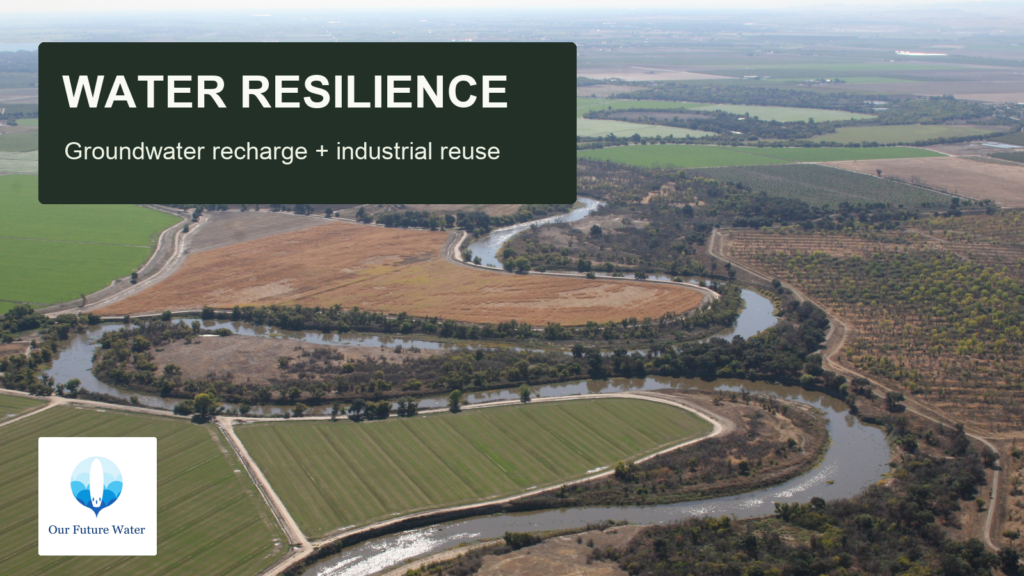
Groundwater recharge directs suitable rainfall, stormwater or other managed flows into aquifers rather than sending all of that water quickly downstream. Infiltration basins and spreading grounds slow flows over permeable land, while engineered injection can place appropriately treated water below ground. Soil and aquifer layers may provide additional filtration, but they do not replace source-water testing or treatment. Recharge therefore works as a planned supply and drainage function: operators must match water quality, available land, storage capacity and aquifer conditions before claiming a reliable contribution.
A healthy aquifer can buffer dry periods and reduce dependence on a single surface-water source. Capturing runoff for recharge can also ease pressure on drainage networks during suitable storms and support connected landscapes where open space is part of the design. These co-benefits depend on careful siting and monitoring: polluted inputs can threaten groundwater, and recharge volumes vary with weather, soils and operations. A resilient programme links hydrology, public health safeguards, land management and transparent accounting so short-term capture supports long-term water security.
The Los Angeles County Flood Control District illustrates managed recharge through spreading grounds that receive captured stormwater and allow it to percolate into local groundwater basins. In the article’s account, reservoirs and controllable structures help route water toward these facilities. The system can retain more local runoff, support aquifer storage and moderate some flood pressure where conditions allow; the article does not establish a guaranteed result for every storm or basin. Read Robert C. Brears’ article on groundwater replenishment for the Los Angeles County illustration and the article’s account of recharge methods. The article was published in 2024; its historical figures should not be read as current operating totals.
Industrial Water Exchange as Circular Supply Infrastructure
Industrial water exchange connects facilities so a water stream leaving one process can serve a suitable purpose elsewhere after the required treatment and quality checks. Shared pipes, utilities and contracts turn isolated plant decisions into a coordinated network. The practical mechanisms include substituting reclaimed process water for new withdrawals, matching water quality to each end use and recovering energy from residual flows. Operators still need clear allocation, monitoring and contingency rules, because a technically reusable stream is not automatically safe or continuously available.
A coordinated exchange can reduce demand for freshwater and lower the volume requiring final disposal. It can also support energy efficiency when heat in water-related flows is recovered for another use. These effects can improve business continuity during water stress and reduce environmental pressure beyond the industrial fence line. Their durability depends on compatible processes, investment in treatment and conveyance, transparent operating agreements and safeguards that protect receiving waters. Circularity is therefore both an engineering choice and a governance commitment, not a promise that every waste stream has a useful buyer.
Kalundborg Symbiosis in Denmark illustrates a network built around exchanges among industrial facilities and shared utilities. The article describes water and wastewater as part of a wider set of resource flows; the network’s own material also documents treated-water and condensate exchanges. Such arrangements can substitute recovered water for some fresh intake, avoid separate disposal of suitable streams and recover useful energy, subject to each connection’s treatment and operating conditions. This is an illustration of coordination, not a claim that every participant receives the same benefit. Read Robert C. Brears’ article on industrial symbiosis and wastewater for the Kalundborg example. Its publication date was 2023, so individual company arrangements should be checked against current operator information before being presented as present-day facts.
Key Takeaways
Groundwater recharge and industrial water exchange keep water available through different but complementary systems. One stores suitable flows in aquifers; the other circulates appropriately treated water between users. Integrated planning, quality assurance and clear institutional responsibilities determine how reliably either system performs. Together, they can strengthen resilience while reducing pressure on freshwater resources and supporting long-term sustainability.
What implementation requires
Recharge projects need a demonstrable water source, a suitable aquifer and a monitoring plan that tests whether water quality remains protective of groundwater and public health. Flood-control and water-supply authorities may share responsibilities, so the accounting must show where captured flows go and who can use stored water. A basin that performs well during one type of storm may not offer the same capacity in a different season.
Industrial exchanges need a different set of controls. Each recipient must specify the quality, volume and reliability required for its process. Treatment, pipework and commercial agreements must allocate the costs and risks of interruptions. Where a shared utility coordinates several firms, transparent rules can help prevent a promising exchange from depending on an informal arrangement between individual sites.
The cases point to a practical sequence: characterize available water; match it to a safe use or storage pathway; build the operating and monitoring framework; then report actual performance. The resilience benefit follows from that sustained discipline rather than from calling a project nature-based or circular.
Key Questions
How does groundwater recharge support urban water resilience?
Managed recharge guides suitable water into an aquifer through infiltration areas or engineered injection. This can store water for later use and, where designed for the purpose, retain some runoff. Water quality, aquifer conditions and monitoring determine whether recharge is appropriate and how much it contributes.
What is industrial water reuse in an industrial symbiosis network?
A facility or shared utility treats a used water stream to the standard required by another process, then moves it through agreed infrastructure. This can replace some freshwater intake and reduce disposal needs, but each link requires quality controls, reliable operation and clear responsibilities.