Key Takeaways
- Smart controls balance rooftop rainwater retention with space for approaching storms.
- Industrial resource planning needs compatible water quality and dependable electricity.
- HYBRIT’s reported emissions result retains its Swedish pilot and Scope 1–2 boundary.
- Integrated governance connects resource conservation with service resilience.
Smart rainwater harvesting and industrial resource efficiency share a practical challenge: making water available for a useful purpose under real operating conditions. A rooftop reservoir needs to retain moisture while leaving room for a storm. A manufacturing process needs water of the right quality alongside dependable energy. Coordinating these functions helps connect individual technologies with the performance of the wider system.
How smart rainwater harvesting supports urban resilience
A rainwater system begins with collection, storage and a defined destination. The destination determines treatment needs; collecting water does not make it suitable for every application. Modular storage can fit constrained urban sites, and sensors can show how much capacity is available. Forecast-informed controls add a timing decision: whether to retain water or release it before more rainfall arrives.
Vegetated roofs make that decision particularly useful. Water held beneath the planted layer can sustain vegetation during dry conditions and support evaporative cooling. At the same time, available storage can help manage storm runoff. Biodiversity, drainage and heat adaptation therefore meet within one piece of infrastructure. Design and maintenance need to recognize these different functions and the tradeoffs between them.
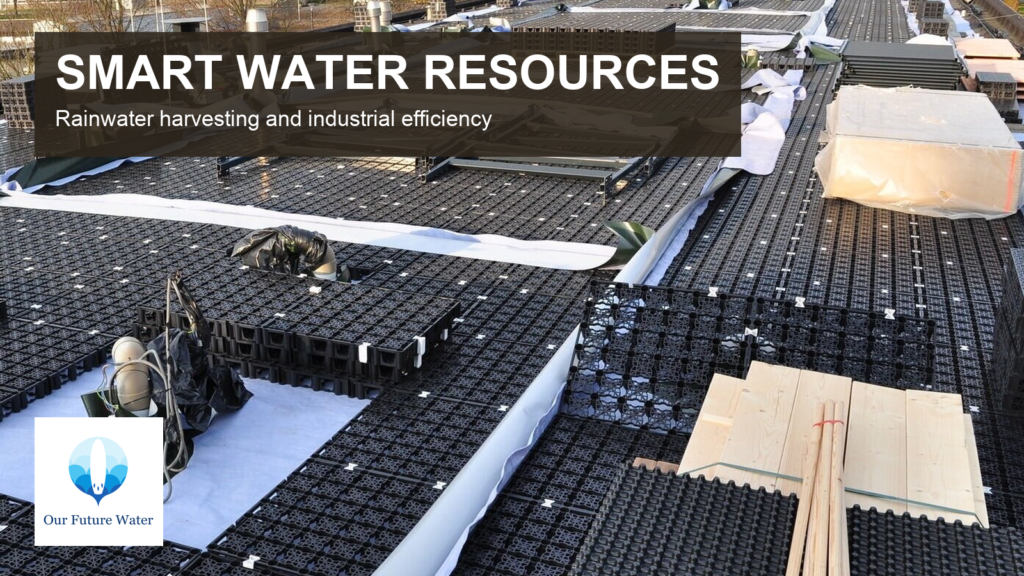
Amsterdam provides the first illustrative case. In his October 2024 article, Robert C. Brears explains how smart blue-green roofs combine water-storage crates with sensors, valves and weather forecasts. Controlled releases create room before heavy rainfall and relieve sewer pressure; retained moisture supports cooling and plant health. Vegetation also provides habitat for birds and insects. These are complementary functions of the described system, rather than a claim that all roofs achieve an identical quantified reduction in flood risk.
Read Robert C. Brears’s article on smart rainwater harvesting and urban resilience for the collection, storage and roof-management mechanisms.
Connecting industrial water with hydrogen and carbon
Industry uses water for cooling, cleaning and processing. Recycling and closed loops can reduce additional freshwater requirements, but the recovered water must match its receiving process. Hydrogen introduces another dependency because electrolysis uses electricity to split water into hydrogen and oxygen. Carbon also has different roles: it can be emitted by an industrial process or used in materials. Planning should distinguish these roles while considering water availability, treatment and electricity together.
The broader benefit is a clearer view of dependencies. Water conservation can support resource security, while changes in energy and material production may contribute to climate objectives. Those outcomes depend on how systems operate and where their inputs come from. A technology label alone cannot establish low emissions or water neutrality. Facility teams need process requirements and source conditions to assess what an intervention can actually deliver.
Supplementary primary evidence provides a concrete industrial case alongside Brears’s broader January 2024 article. HYBRIT, the SSAB, LKAB and Vattenfall partnership, includes pilot work in Luleå, Sweden. Its 2018–2024 research connected water electrolysis, hydrogen-based ore reduction and electric steelmaking. The partners reported validated process settings and 0.0 metric tons of carbon dioxide equivalent per metric ton of steel for Scope 1 and Scope 2 under Swedish pilot conditions. Replacing coal with hydrogen produces water at the reduction step. The reported pilot boundary does not establish zero lifecycle emissions or sector-wide commercial conversion.
The HYBRIT partners’ pilot research results supply the case evidence. Read Robert C. Brears’s article on the integrated roles of water, hydrogen and carbon for the wider industrial resource framing.
Planning for resource efficiency across systems
Rainwater harvesting and industrial water management both work through connections between resources, assets and operating decisions. An integrated plan should identify the function of each asset, the organization responsible for it and the evidence needed to assess performance. Considering immediate service alongside biodiversity, climate and resource dependencies gives resilience and sustainability a practical basis.
Latest from Water Intelligence Brief
Making recovered water useful in production
Our October industrial reuse public briefing examines established manufacturing recovery and Denmark’s operating brewery recycling. The examples connect treatment with a defined production duty. For readers considering circular industry, the useful question is whether recovered water can reliably serve its intended process, rather than whether a recycling technology has attracted attention. Read the public briefing
Latest from Our Future Water Intelligence
Following HOFOR’s different resilience priorities
Our public HOFOR analysis separates distribution water loss from the supply buffer and metropolitan rainfall adaptation. Local renewal work and cloudburst-tunnel procurement provide different evidence of progress. This helps readers connect urban water management with the operating measures and delivery stages that actually describe each part of the system. Read the public article · Our Future Water Intelligence Editorial
Matching Qatar’s reused water with seasonal demand
Our public Qatar analysis explains how seasonal storage can connect a winter treated-water surplus with summer irrigation needs. Conveyance, storage and delivery each perform a different function. For readers exploring resource efficiency, the article clarifies why treatment capacity alone cannot demonstrate useful reuse or the amount of groundwater actually displaced. Read the public article · Our Future Water Intelligence Editorial
Photo: Marineterrein Living Lab, CC BY 3.0. Cropped, resized and overlaid with newsletter text and the Our Future Water logo.
For more from our publications, follow the dedicated Water Intelligence Brief and Our Future Water Intelligence newsletters.
Key Questions
How do smart blue-green roofs manage rainfall?
Storage beneath vegetation holds rainwater. Sensors and forecast-informed valves control retention and release, creating room before heavy rainfall while retaining water to support plants during dry conditions.
Does hydrogen-based steelmaking prove zero lifecycle emissions?
No. The HYBRIT partners report 0.0 metric tons of carbon dioxide equivalent per metric ton of steel for Scope 1 and Scope 2 under Swedish pilot conditions. That boundary is not a zero-lifecycle-emissions claim or evidence of sector-wide conversion.
What connects rainwater harvesting and industrial resource efficiency?
Both depend on matching water with an appropriate function through storage, quality control and operating decisions. Integrated planning considers those functions alongside resource availability and the responsibilities of the organizations involved.