Key Takeaways
- Green roofs can retain rainfall while sharing space with solar generation.
- Circular water systems combine demand reduction, suitable reuse and recovery.
- Financial support enables projects but does not prove operating performance.
- Design, maintenance and safe destinations sustain the resource benefits.
Green roofs and circular water systems connect urban resilience with better use of existing space and resource flows. A roof can retain rainfall while generating solar electricity; a treatment plant can recover energy and nutrients alongside its water services. The practical question is how to connect those functions without overstating what an installation or funding announcement proves. Berlin’s roof-support programs and Thames Water’s sludge recovery illustrate different parts of that task.
How green roofs connect rainfall and solar energy
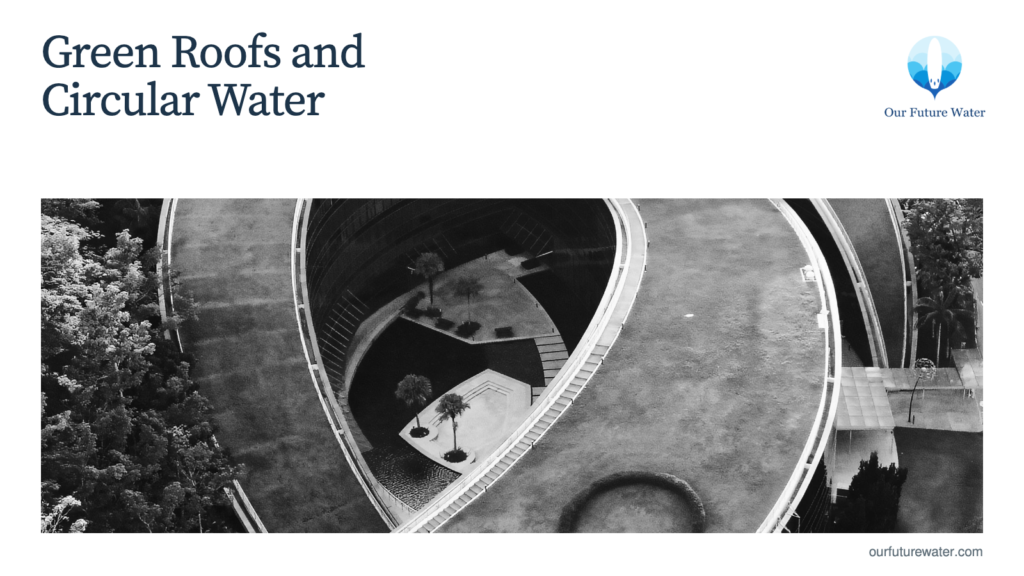
Vegetated roofs hold rain in their growing medium. Some moisture returns to the atmosphere through evaporation and transpiration, while retained water can reduce or delay discharge to the drainage system. This gives a building surface a role in managing runoff close to where rain falls. The effect depends on the roof, its planting and the conditions it experiences; a roof installation alone does not establish a citywide reduction in flood losses.
Solar panels add electricity generation to that same surface. Plants can moderate the surrounding temperature, creating a potential benefit for photovoltaic efficiency. The combination is therefore about arranging complementary functions within limited space. It requires a suitable roof and a design that preserves the drainage and vegetation functions alongside the equipment. Different buildings and climates will produce different results.
Habitat, lower local heat and reduced building energy demand widen the potential benefits. They also make maintenance part of the resource strategy. Vegetation and drainage must continue working if the installation is to retain its intended service. These requirements connect individual property decisions with the wider environmental aims of an urban water plan.
Berlin illustrates the role of roof investment incentives
Robert C. Brears’s December 2024 article describes Berlin’s GründachPLUS and SolarPLUS programs in the context of green roofs and photovoltaics. Financial support can help building owners consider vegetation and energy equipment as part of an investment decision. The physical aims include rainfall retention, cooler roof environments and renewable electricity, rather than a reported numerical improvement across the entire city.
The example should be read in its original policy context. Funding conditions have evolved: Berlin’s current GründachPLUS information describes support related to substrate depth and additional eligible costs where solar equipment is installed over part of the vegetated area. The newsletter does not repeat the older article’s grant rates as current offers or imply that two grants can automatically be combined. Eligibility needs to be checked against the applicable program rules.
This is an incentive mechanism. It should be distinguished from any separate building obligation. Funding can enable a project, but the award itself does not verify the resulting runoff or energy performance. The useful connection is between the public objective, the design selected by the owner and the operating evidence needed to assess its contribution.
Read Robert C. Brears’s article on green roofs with solar panels for the original explanation and Berlin example.
Circular water systems start with conservation
Resource recovery works alongside efforts to use less water. Efficient fittings, irrigation matched to crop needs and monitoring can reduce unnecessary withdrawals. Treatment then creates opportunities to use water again where its quality matches the intended destination. Conserving water and reusing treated flows address different points in the system, so neither should be treated as an automatic substitute for the other.
Wastewater also carries nutrients and organic material. Recovering these outputs can connect treatment with agriculture and energy production. Anaerobic digestion turns some organic matter into biogas, while appropriately treated biosolids can supply nutrients or improve soils. A circular approach therefore involves several pathways, each with its own processing needs and receiving use.
Those connections can reduce pressure on freshwater and other resource inputs. Their value depends on safe treatment and an appropriate destination, with public health and environmental protection remaining essential. Planning across the organizations producing and receiving recovered resources helps connect technical capability with practical use. Having a potentially useful output does not by itself establish a dependable recovery service.
Thames Water links sludge treatment with useful outputs
Brears’s October 2024 article uses Thames Water’s sludge management as its case. The company’s public description explains that most sludge is treated through anaerobic digestion, producing biogas for combined heat and power engines at major sites. It also describes biosolids recycling to agriculture and land restoration, with some incineration and energy recovery at Beckton and Crossness in London.
The energy pathway produces a usable fuel from organic treatment residuals. The land-use pathway returns treated material to a productive destination. Together they show how wastewater services can connect with activities beyond the treatment works. They do not establish that every part of the water cycle has been closed, nor do they remove the need to assess the suitability of each output.
Thames Water identifies controls on biosolids quality and crop application, alongside energy, transport, odor and local constraints in its sludge strategy. Recovery should therefore be understood as a managed service, with conditions that must continue to be met. The relevant result is useful material or energy delivered safely, rather than a circularity label applied to all residuals without qualification.
Read Robert C. Brears’s article on circular water strategies for the wider connections between conservation, recovery and the Thames Water case.
Planning for connected urban services
Green roofs organize several functions on a building surface; circular water systems organize several uses of a resource flow. Both benefit from a clear account of the service each intervention is meant to deliver. Rainfall retention, electricity generation, safe reuse and nutrient recovery should be assessed within their own operating boundaries before their wider contribution is claimed.
For urban decision-makers, the shared task is to connect design and investment with responsibilities for continuing operation. An incentive, installation or treatment capability is one part of that sequence. Keeping the relevant functions working supports resilience and more sustainable use of land, water and materials.
Latest from Water Intelligence Brief
Making recovered water work for cooling
Our October industrial-cooling public briefing examines reclaimed makeup water, condensate recovery and operating controls. It explains why the quality and timing of an alternative supply matter alongside its volume. These practical connections help readers assess how water reuse can support cooling service without assuming that a project announcement proves operating savings. Read the public briefing
Latest from Our Future Water Intelligence
Rainfall and Hamburg’s sewer overflows
Our public Hamburg article compares sewer overflows in wet 2023 with those in 2025 and connects the difference with rainfall and sealed surfaces. It also distinguishes sponge-city pilots from a broader program. The account gives practical context for considering distributed rainfall retention alongside the capacity of established drainage networks. Read the public article · Our Future Water Intelligence Editorial
Understanding Perth’s changing water sources
Our public Perth article explains how groundwater and desalination dominated metropolitan water supply in the reported financial year, while hills dams supplied less than a tenth. It also places groundwater replenishment within that wider source picture. Understanding those different roles helps readers connect reuse with resource limits and dependable urban service. Read the public article · Our Future Water Intelligence Editorial
For more from our publications, follow the dedicated Water Intelligence Brief and Our Future Water Intelligence newsletters.
Key Questions
How can green roofs and solar panels work together?
Vegetation can retain rainfall and moderate the temperature around panels, while panels generate electricity. Their combined contribution depends on a roof design that accommodates planting, drainage and equipment.
What does a circular water system recover?
Alongside suitable water reuse, treatment can recover nutrients and energy from wastewater. Anaerobic digestion produces biogas, and appropriately treated biosolids can supply nutrients or support land restoration.
Do the Berlin grant figures in the original article describe current offers?
The article discusses the programs in its original context. Funding conditions have changed, so current eligibility and any combination of support must be checked against the applicable program rules.