Key Takeaways
- Monitoring supports conservation when data leads to a practical operational response.
- Barcelona’s irrigation saving estimate must retain its specific scope.
- Climate-smart farming connects irrigation, soil condition, and productive landscapes.
- Program funding and intended benefits need to be distinguished from measured outcomes.
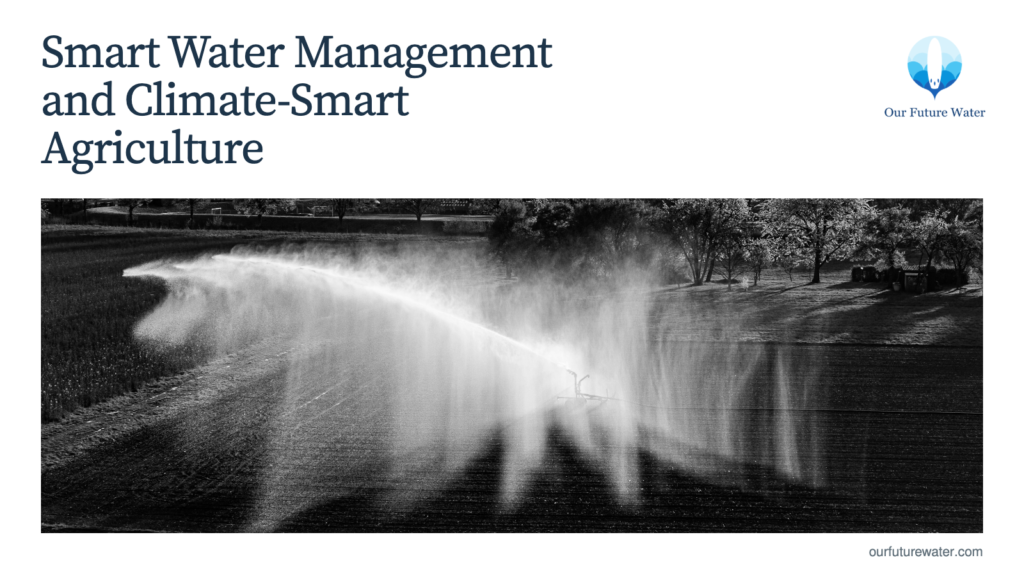
Smart water management and climate-smart agriculture share an implementation challenge: information must change how water is used. Connected sensors can guide irrigation and maintenance, while soil management and rainwater harvesting can help crops make better use of available moisture. The connection is practical. Measurements, equipment, skills, and responsibility for action have to work together if conservation is to support reliable services and productive landscapes.
How connected monitoring supports water management
Smart water systems combine sensors, communications, and analysis. Readings can reveal unusual consumption, help identify a possible leak, or show that irrigation settings need attention. Their value depends on the response that follows. Operators need information they can interpret, equipment they can adjust, and a clear process for deciding when to investigate or intervene.
That operational connection can reduce avoidable use and help maintenance teams target developing problems. Where irrigation supports public vegetation, applying water according to plant needs can also protect green space while conserving supplies. Those benefits require continuing maintenance and follow-through. Installing a sensor does not by itself establish a reduction in demand or an improvement in the reliability of the wider water network.
Barcelona’s remotely managed park irrigation
Barcelona provides a concrete example within urban landscape management. Municipal documentation from 2014 described a system that used sensors and remotely operated valves to optimize irrigation in city parks. It reported potential savings of around 25% relative to the preceding irrigation approach. The scope matters: this was a park-irrigation comparison, not an independently established reduction of 25% across the city’s entire water consumption.
The example connects monitoring with control of an actual water use. Operators can adjust irrigation remotely, target watering more closely, and avoid unnecessary applications. Robert C. Brears’s article on smart water management and Barcelona introduces the wider relationship among data, conservation, and infrastructure decisions. Its historical example should be read in that context rather than as a description of every part of Barcelona’s current water system.
How climate-smart agriculture connects soil and water
In farming, efficient application is one part of a broader water-management system. Precision irrigation can align applications with crop requirements. Rainwater harvesting can capture supplies for use when rainfall is less dependable. Cover cropping, agroforestry, and conservation tillage help maintain soil structure and moisture retention, affecting how effectively available water supports crop growth. The appropriate combination depends on local soils, crops, climate, and operating capacity.
Managing those relationships can support production alongside environmental stewardship. Soil practices that maintain organic matter can contribute to climate mitigation, while protecting natural capital and biodiversity helps preserve the resource base on which agriculture depends. Water resilience is therefore linked to the long-term viability of farming. Advice, skills, and access to workable implementation support help turn a suitable practice into something that can be maintained within a farm business.
Australia’s Climate-Smart Agriculture Program
Australia’s Climate-Smart Agriculture Program illustrates how institutions can support that transition. Established through the Natural Heritage Trust, the program commits funding over five years from 2023 to 2028 for sustainable farming. Its investment streams support projects, knowledge, soil information, and delivery capacity. The stated objectives include climate resilience, emissions reduction, protection of natural capital, and agricultural productivity.
These are intended program outcomes. A funding commitment does not establish uniform water savings, higher yields, or emissions reductions on every participating farm. It creates support for adoption that must be assessed through actual delivery and results. Robert C. Brears’s article on climate-smart agriculture and the water-food nexus explains the program alongside the water and soil practices it is designed to support. The program is an example of investment and incentives, rather than a universal mandatory farming requirement.
Connect information with the capacity to act
Both examples show why the management boundary should extend beyond an individual technology. Monitoring needs working equipment and a response process; agricultural adaptation needs suitable land practices and the ability to sustain them. Integrated planning can connect those responsibilities while keeping expected benefits separate from demonstrated performance. That provides a sounder basis for dependable water services, productive land, and long-term climate resilience.
Latest from Water Intelligence Brief
Making Irrigation Data Usable
Our agriculture public briefing connects soil moisture sensing with irrigation scheduling, equipment maintenance, and practical training. Its Florida workshop example shows why instrumentation belongs within a wider operating process. For farmers and advisers, the distinction matters: a training announcement describes support for better decisions, without demonstrating measured water savings on participating farms.
Read the public briefing · Water Intelligence Brief
Latest from Our Future Water Intelligence
Thames Water’s Metering Service Procurement
Our public article examines Thames Water’s planned smart-metering service, separating meters and installation from communications and data responsibilities. It explains the proposed contract timetable alongside existing installations and demand pressures. This helps readers assess how a procurement could support dependable information without treating an expected award as an operating service.
Read the public article · Our Future Water Intelligence Editorial
Kuwait’s Groundwater and Agricultural Demand
Kuwait’s groundwater pressure links agricultural demand with a separate brackish-water network and limited natural replenishment. Our public article compares withdrawal and inflow estimates while preserving their original reporting periods. It introduces the resource constraints behind efficiency decisions and explains why installed well capacity cannot establish whether an aquifer is being used sustainably.
Read the public article · Our Future Water Intelligence Editorial
For more from our publications, follow the dedicated Water Intelligence Brief and Our Future Water Intelligence newsletters.
Key Questions
How does smart water monitoring help conserve water?
Sensors and analysis can identify unusual consumption and guide irrigation or maintenance. Conservation depends on operators being able to respond and equipment functioning as intended; monitoring alone does not establish a measured saving.
Does Barcelona’s 25% figure cover all city water use?
No. The municipal evidence used here describes potential savings from remotely managed park irrigation relative to its preceding approach. It should not be generalized to all water consumption across Barcelona.
What does Australia’s Climate-Smart Agriculture Program demonstrate?
It demonstrates institutional support for sustainable farming through funding, knowledge, and soil information. Its objectives include resilience, emissions reduction, natural capital, and productivity; those objectives do not prove uniform measured results on participating farms.