Key Takeaways
- Urban agriculture can combine local food production with rainfall retention and other green infrastructure functions.
- Nature-based planning can connect stormwater management, urban cooling, habitat and accessible public space.
- Long-term results depend on secure land access, coordinated investment and ongoing maintenance.
Welcome to this week’s edition of the “Our Future Water” newsletter. Urban agriculture and nature-based solutions can help cities manage water, heat, food access and public space together. The practical question is how to make these green assets part of routine infrastructure planning, with appropriate land access, funding and maintenance.
Insights
Urban Agriculture as Distributed Green Infrastructure
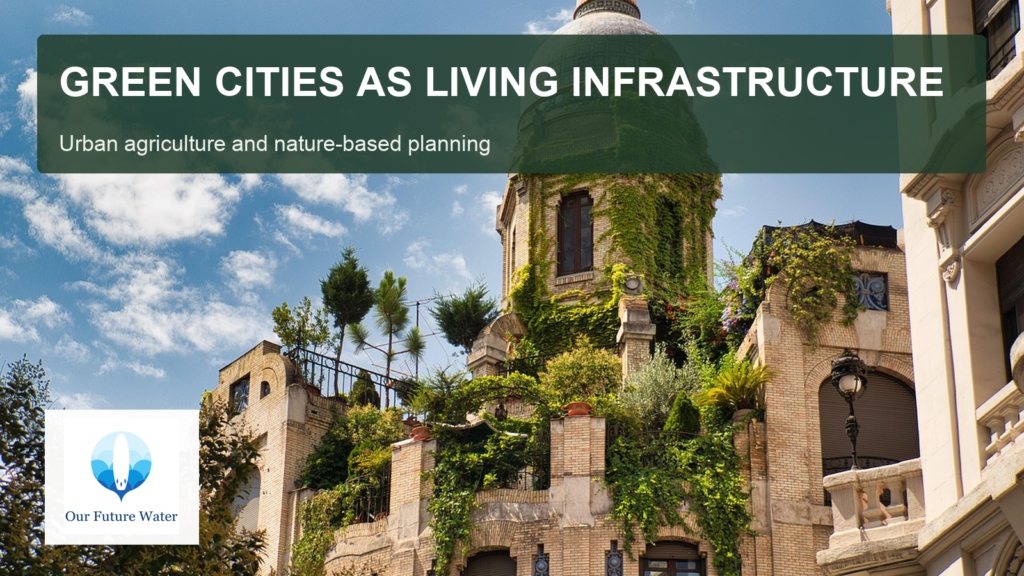
Urban agriculture brings food production into rooftops, ground-level plots, greenhouses and other urban spaces. When its growing areas are designed alongside rain gardens, wetlands and other green infrastructure, they can retain rainfall, slow runoff and use captured water for plant growth. This creates a connection between food and water planning, but the site still needs suitable soil, safe water and a reliable maintenance plan.
The benefits extend beyond drainage. Productive green spaces may improve access to fresh food, create habitat, moderate heat and offer places for training and community activity. These outcomes are not automatic. Land security, water quality, practical growing methods and long-term stewardship determine whether the space can continue serving both people and the wider urban environment.
The Massachusetts Department of Agricultural Resources’ Urban Agriculture Program illustrates the policy side of this work. The programme supports eligible commercial urban-growing projects and related infrastructure, with aims that include increasing local produce, improving distribution to lower-income neighbourhoods and supporting youth development and small businesses. These are programme aims, not measured results for every project. Read Robert C. Brears’ article on urban agriculture and green infrastructure for the programme detail and its connection to city planning.
Nature-Based Planning as Urban Resilience Infrastructure
Nature-based planning gives parks, urban forests, wetlands, rain gardens and vegetated buildings defined jobs in the city. These assets can intercept rain, encourage infiltration, filter runoff and cool nearby areas through shade and evapotranspiration. Treating them as infrastructure means identifying where they belong, who maintains them and how their performance connects to drainage and land-use decisions.
Connected green space can also support biodiversity, public health and access to recreation. A wetland or tree canopy can serve several goals at once, but only when agencies coordinate location, funding and care. Community input matters because the distribution of shade, green space and flood protection affects who receives those benefits.
Plan Melbourne 2017–2050 is an example of a metropolitan planning approach that incorporates urban forests, parks, wetlands, rain gardens and habitat corridors. Its stated measures aim to address heat, stormwater, biodiversity and public well-being across a growing city. The plan is an illustration of integrated policy design, not proof that every proposed outcome has been achieved. Read Robert C. Brears’ article on nature-based solutions in cities for the planning mechanisms and Melbourne example.
Key Takeaways
Urban agriculture and nature-based planning work best when cities treat them as connected systems for water, food, heat, habitat and public space. Integrated land-use decisions, funding, community participation and maintenance can help these distributed assets deliver lasting infrastructure value while strengthening urban resilience and sustainability.
Key Questions
How can urban agriculture help manage stormwater?
Growing spaces can retain rainfall and slow runoff when they are designed with suitable soils, rain gardens, wetlands or captured-water systems. Their water role depends on site conditions and ongoing maintenance; food production alone does not guarantee stormwater performance.
What makes nature-based planning part of urban resilience?
Planning can connect parks, urban forests, wetlands, rain gardens and other green assets to drainage, heat, habitat and public-space goals. Cities need to coordinate land use, funding and maintenance so those functions remain effective over time.