Welcome to this week’s edition of the “Our Future Water” newsletter.
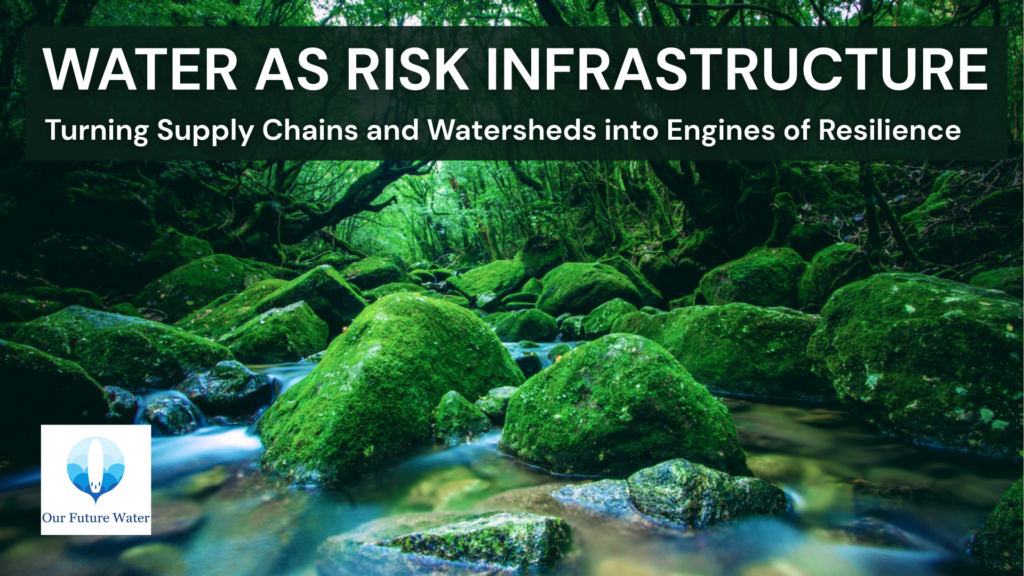
Across urban regions facing densification, climate stress, and infrastructure capacity limits, water risk is no longer confined to utilities; it extends through supply chains and source landscapes. The common thread is the governance of water as core infrastructure: from corporate networks to protected catchments, socio-technical systems must function as risk-management assets that secure reliability, reduce exposure, and sustain urban economies under mounting pressure.
Insights
Corporate Supply Chain Water Stewardship as Risk Management Infrastructure
Corporate supply chain water stewardship is a structured approach to identifying, assessing, and mitigating water-related risks across interconnected production networks. As functional infrastructure, it integrates risk assessment, demand reduction, reuse, and pollution prevention into procurement and supplier management processes. Mechanisms include water efficiency improvements within facilities, recycling and reuse systems that reduce freshwater withdrawals, and compliance monitoring to prevent contamination and regulatory breaches. Through distributed control across suppliers, companies embed water management directly into operational decision-making.
Beyond operational continuity, this approach generates co-benefits across climate regulation, public health, and social resilience domains. Reduced abstraction and improved discharge quality support ecosystem stability and biodiversity, while lowering energy demand associated with water treatment and pumping contributes to climate mitigation. Transparent standards and supplier collaboration strengthen institutional trust and reduce reputational exposure. Collectively, these measures enhance long-term resilience by stabilizing input availability, limiting regulatory risk, and aligning corporate performance with sustainable resource governance.
Apple’s Clean Water Program illustrates this model within a global supply chain. The program works with suppliers to secure appropriate permits, improve process water treatment, and implement conservation and recycling measures across high-use facilities. Outcomes include substantial reductions in freshwater withdrawals, improved wastewater quality control, and lower operational risks associated with regulatory compliance and contamination.
Read the full article by Robert C. Brears to learn how structured supplier engagement and water performance standards can reduce systemic supply chain risk while strengthening environmental governance.
Source Water Protection Governance as Preventive Infrastructure
Source water protection governance treats catchments, aquifers, forests, and agricultural lands as preventive infrastructure that safeguards drinking water before contamination occurs. As a system element, it integrates land-use regulation, conservation easements, pollution control, and ecosystem management to maintain water quality at its source. Core mechanisms include filtration through protected forests and wetlands, recharge through permeable landscapes, and restrictions on point and non-point pollution sources. By prioritizing prevention, utilities reduce reliance on downstream treatment and avoid costly technological retrofits.
The co-benefits extend across biodiversity conservation, climate adaptation, and community well-being. Protected landscapes sustain habitats and ecological connectivity while stabilizing soils and moderating flood and drought cycles. Safeguarding source waters reduces exposure to waterborne health risks and strengthens social resilience by ensuring reliable drinking water supplies. Over the long term, integrating watershed governance into urban planning supports financial sustainability by lowering treatment costs and preserving strategic natural assets under changing climatic conditions.
Vienna’s constitutional protection of drinking water through the Vienna Water Charter demonstrates this preventive model. The city safeguards source-protection forests that filter and store rainwater, maintain soil integrity, and shield water from pollutants. By embedding protection in constitutional and land management frameworks, the system secures high-quality raw water, reduces treatment burdens, and strengthens supply reliability.
Read the full article by Robert C. Brears to understand how legal instruments and forest management function together as infrastructure that protects urban water security at its source.
Key Takeaways
Corporate supply chain water stewardship and source water protection governance both function as infrastructure embedded within broader socio-technical systems. When integrated into planning and regulatory frameworks, these approaches improve system performance, reduce risk exposure, and align economic activity with resource limits. Treating water management as preventive and distributed infrastructure is central to advancing urban resilience and long-term sustainability.
Circular Economy and Liveable Cities (Cambridge University Press)
The Circular Economy and Liveable Cities, edited by Robert C. Brears, Our Future Water, has been published. This essential guide delivers actionable strategies and best practices for implementing circular economy, climate resilience, and sustainability in urban environments, with global examples from leading cities like Tokyo, New York, and Singapore to help planners, policymakers, and researchers build liveable and sustainable cities for the future.
2nd Edition of Nature-Based Solutions to 21st Century Challenges (Routledge)
Fully revised and updated, the second edition of Nature-Based Solutions to 21st Century Challenges by Robert C. Brears offers a timely and systematic review of how working with nature can address today’s most pressing environmental and societal issues. Featuring new case studies from across the globe, expanded insights on public policy, AI, and community-led initiatives, this edition is essential reading for anyone shaping a sustainable future.
Stay Connected & Gain Exclusive Water Insights
🔹 Stay ahead in water innovation! 👉 Sign up for Our Future Water’s LinkedIn newsletter for expert insights and industry trends.
🔹 Want in-depth Middle East water insights? 👉 Subscribe to the Middle East Water Tech Brief for exclusive analysis on desalination, AI innovations, mega-projects, and climate-resilient water investments.
🔹 Join the conversation in the following LinkedIn groups:
Urban Water Security, Our Future Water, Circular Water Economy, Blue-Green Infrastructure, Nature-Based Solutions, Climate Resilient Water Resources Management, Water Governance, Global Climate Solutions, Nature-Based Water Management
📚 Shape the Future of Sustainability: Contribute to Springer Nature’s Landmark Publications
As Editor-in-Chief, Robert C. Brears invites experts, researchers, and practitioners to contribute to impactful and forward-thinking publications from Springer Nature. These comprehensive Handbooks and Encyclopedias explore Nature-Based Solutions, sustainable resource management, ecosystem well-being, and the global energy transition.
- Palgrave Handbook of Nature-Based Solutions
- Palgrave Encyclopedia of Sustainable Resources and Ecosystem Resilience
- Palgrave Handbook of Ecosystems and Human Well-Being
- Palgrave Handbook of Energy Transition and Renewable Energy
- Palgrave Handbook of Urban Climate and Disaster Resilience
- Palgrave Handbook of Social Transformations in Science, Innovation, and Education
📚 Shape the Future of Climate Resilience: Contribute to Palgrave’s Pivot Series
As Series Editor, Robert C. Brears invites experts to contribute to Palgrave Studies in Climate Resilient Societies, a leading Pivot series (25,000–50,000 words) exploring climate resilience, policy innovation, and sustainability strategies.
📩 For more details, visit: Seeking Authors — Palgrave Studies in Climate Resilient Societies
📚 Explore the Full Book Collection on Sustainable Water Management Solutions
Strengthen global water security with practical knowledge from Our Future Water. This collection presents forward-looking strategies for managing water equitably, efficiently, and sustainably in a rapidly changing world.
🔎 Strategies for effective, equitable, and climate-resilient water use
💧 Tools spanning smart technologies, pricing models, and governance frameworks
📈 Solutions designed to support long-term water sustainability and innovation
Click here to explore the complete collection.