Welcome to this week’s edition of the “Our Future Water” newsletter.
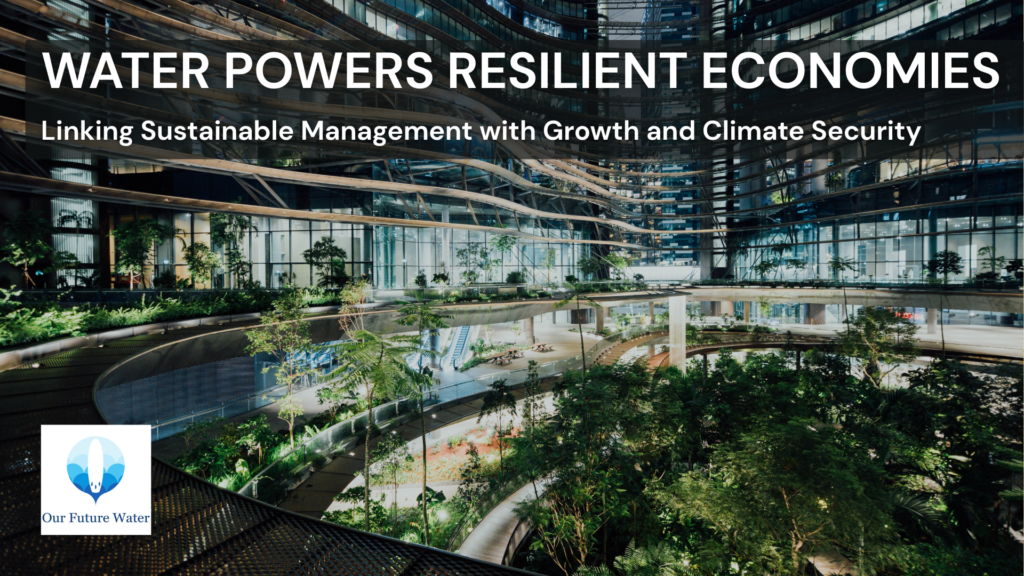
This issue explores how water underpins economic growth and climate resilience. From the critical role water plays across agriculture, manufacturing, and energy systems to the growing importance of alternative water sources in a warming world, these insights highlight why sustainable water management is fundamental to both economic prosperity and long-term urban resilience.
Insights
Water for Jobs and Economic Growth: Why Sustainable Management Matters
Water acts as a foundation for economic development, supporting agriculture, manufacturing, energy production, and public services. As global demand rises and climate pressures intensify, ensuring secure, clean, and efficiently managed water resources is vital for maintaining stable economies. When water becomes scarce or polluted, industries face higher costs, supply chains weaken, and communities lose employment opportunities — making sustainable water governance a central economic priority.
Across multiple sectors, advances in water efficiency, wastewater reuse, and pollution reduction are strengthening productivity while creating green jobs. Improved irrigation systems increase yields and raise farm incomes, water-efficient technologies lower industrial risks, and modern water treatment and distribution networks generate employment in engineering, operations, and maintenance. These improvements demonstrate how sustainability and economic growth reinforce one another.
Read the full article by Robert C. Brears to explore how strategic investment in clean water access, infrastructure upgrades, and efficiency technologies can drive job creation across agriculture, manufacturing, and the broader water services sector — supporting inclusive and resilient economic development.
Alternative Water Sources for a Changing Climate: Building Urban Resilience
Climate change is reshaping global water availability through more frequent droughts, shifting rainfall patterns, and declining surface water reliability. To adapt, cities are diversifying their water portfolios by integrating alternative sources such as rainwater harvesting, stormwater capture, wastewater recycling, and desalination. This diversification reduces vulnerability, enhances redundancy, and helps communities maintain reliable water supplies in periods of stress.
Technological innovation is expanding what these systems can achieve. Smart controls, advanced filtration, and nature-based designs are improving water quality, reducing flood risk, and supporting sustainability goals. As reliance on traditional water sources becomes increasingly uncertain, alternative supply development is becoming a core pillar of climate resilience strategies worldwide.
Read the full article by Robert C. Brears to learn how Santa Monica’s Sustainable Water Infrastructure Project (SWIP) captures and treats stormwater, wastewater, and dry-weather runoff to strengthen local water security — showcasing how integrated alternative sources can reduce dependence on imported water and prepare cities for long-term climate impacts.
Key Takeaways
Water drives economic opportunity, and resilient water systems protect communities from climate uncertainty. By investing in sustainable water management, expanding alternative supply sources, and improving infrastructure efficiency, cities can secure job growth, safeguard public health, and enhance long-term resilience in a rapidly changing world.
Newly Published: Circular Economy and Liveable Cities (Cambridge University Press)
The Circular Economy and Liveable Cities, edited by Robert C. Brears, Our Future Water, has been published. This essential guide delivers actionable strategies and best practices for implementing circular economy, climate resilience, and sustainability in urban environments, with global examples from leading cities like Tokyo, New York, and Singapore to help planners, policymakers, and researchers build liveable and sustainable cities for the future.
Coming Soon — 2nd Edition of Nature-Based Solutions to 21st Century Challenges (Routledge)
Fully revised and updated, the second edition of Nature-Based Solutions to 21st Century Challenges by Robert C. Brears offers a timely and systematic review of how working with nature can address today’s most pressing environmental and societal issues. Featuring new case studies from across the globe, expanded insights on public policy, AI, and community-led initiatives, this edition is essential reading for anyone shaping a sustainable future.
Stay Connected & Gain Exclusive Water Insights
🔹 Stay ahead in water innovation! 👉 Sign up for Our Future Water’s LinkedIn newsletter for expert insights and industry trends.
🔹 Want in-depth Middle East water insights? 👉 Subscribe to the Middle East Water Tech Brief for exclusive analysis on desalination, AI innovations, mega-projects, and climate-resilient water investments.
🔹 Join the conversation in the following LinkedIn groups:
Urban Water Security, Our Future Water, Circular Water Economy, Blue-Green Infrastructure, Nature-Based Solutions, Climate Resilient Water Resources Management, Water Governance, Global Climate Solutions, Nature-Based Water Management
Shape the Future of Sustainability: Contribute to Springer Nature’s Landmark Publications
As Editor-in-Chief, Robert C. Brears invites experts, researchers, and practitioners to contribute to impactful and forward-thinking publications from Springer Nature. These comprehensive Handbooks and Encyclopedias explore Nature-Based Solutions, sustainable resource management, ecosystem well-being, and the global energy transition.
- Palgrave Handbook of Nature-Based Solutions
- Palgrave Encyclopedia of Sustainable Resources and Ecosystem Resilience
- Palgrave Handbook of Ecosystems and Human Well-Being
- Palgrave Handbook of Energy Transition and Renewable Energy
- Palgrave Handbook of Urban Climate and Disaster Resilience
- Palgrave Handbook of Social Transformations in Science, Innovation, and Education
Shape the Future of Climate Resilience: Contribute to Palgrave’s Pivot Series
As Series Editor, Robert C. Brears invites experts to contribute to Palgrave Studies in Climate Resilient Societies, a leading Pivot series (25,000–50,000 words) exploring climate resilience, policy innovation, and sustainability strategies.
📩 For more details, visit: Seeking Authors — Palgrave Studies in Climate Resilient Societies
Explore the Full Book Collection on Climate Mitigation & Adaptation Solutions
Confront climate challenges with actionable strategies from Our Future Water and Global Climate Solutions. This collection bridges policy, infrastructure, and innovation to support emissions reduction and long-term resilience across all scales.
📉 Approaches for cutting emissions and strengthening adaptive capacity
🛠️ Tools to design climate-resilient infrastructure and integrated planning systems
🧭 Frameworks for coordinated action at national, regional, and local levels
Click here to explore the complete collection.