Key Takeaways
- Groundwater reserves require suitable water, a compatible aquifer and a practical route to recovery.
- Storage credits record eligible reserves; delivery depends on infrastructure and coordination with recovery partners.
- Water partnerships need clear responsibilities and continuing oversight to turn treatment capacity into reliable services.
Groundwater banking and water partnerships address a common question in water resilience: how does available capacity become a dependable service? An aquifer can hold a reserve, and a treatment plant can add capacity. Both require operating arrangements that connect water resources with the people who depend on them. The two articles in this Our Future Water edition examine the physical and institutional parts of that connection.
Why storage and service delivery need shared planning
Storage and treatment serve different purposes, but each depends on decisions beyond the asset itself. A reserve needs a suitable water source, protective quality controls and an agreed route to recovery. A treatment project needs technical competence and a service framework that defines responsibilities. Planning these requirements together helps avoid counting infrastructure capacity as a guarantee of supply.
Insights
Groundwater Banking as Drought Resilience Infrastructure
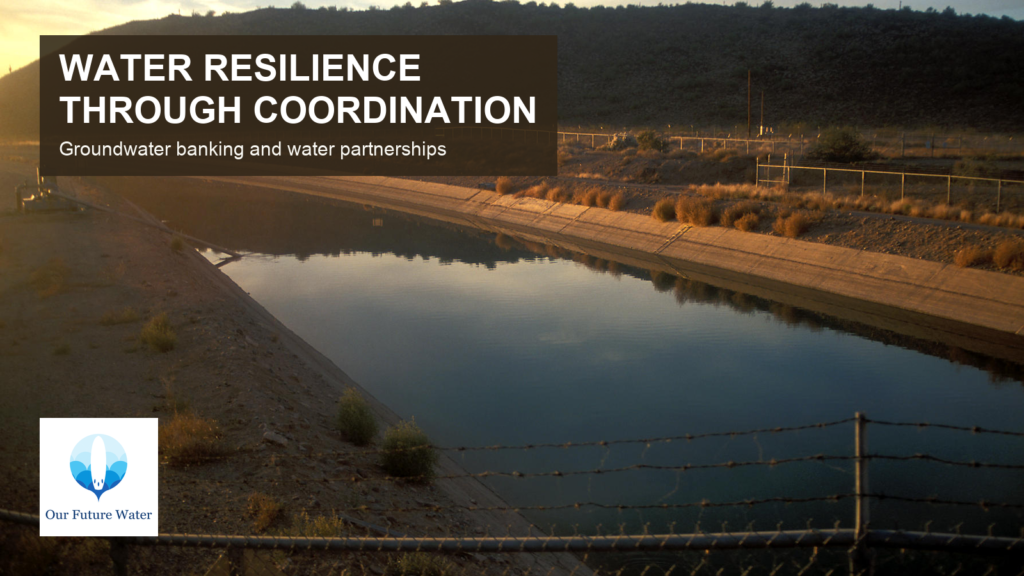
Groundwater banking makes an aquifer part of a managed supply strategy. Direct recharge moves suitable water underground through infiltration or other permitted methods. Indirect recharge substitutes another supply for groundwater that would otherwise have been pumped. Storage accounting records eligible reserves, while monitoring provides information about aquifer conditions. A usable bank therefore combines hydrology with records and recovery planning.
The potential benefit is a buffer against constrained surface supplies. That can support household services and continuity for businesses, while substitution can reduce some pressure on groundwater. The result depends on how much suitable water is available, how withdrawals are controlled and whether the reserve can be accessed when needed. Recharge also needs water-quality safeguards; natural filtration cannot be assumed to resolve every contaminant.
The Arizona Water Banking Authority provides the first illustration. In Arizona, United States, it uses permitted recharge and groundwater savings to accumulate long-term storage credits for backup supplies during Colorado River shortages. The programme links underground reserves with eligible uses through an accounting framework. Its contribution includes holding water underground and, where substitute supplies are delivered, leaving groundwater unpumped.
Recovery adds a separate operational requirement. The Authority’s own recovery guidance explains that it relies on partners to recover stored water. The route may involve direct recovery, delivery through other infrastructure or credit exchange. A recorded reserve and a delivered supply are therefore distinct steps. Responsibilities and infrastructure must connect them before a stored balance can support water users.
Water Partnerships as Service Reliability Infrastructure
Water partnerships organise specialist contributions around a service objective. Depending on the arrangement, public bodies, utilities, suppliers and other participants can coordinate investment, share knowledge and allocate responsibility for delivery. Effective agreements make those roles understandable. Public oversight and equipment expertise support different tasks, and both need to remain connected to the needs of water users.
Collaboration can support public health through dependable treatment and help operators respond to changes in source-water quality. It can also make service needs more visible in planning and support economic activity that depends on reliable supply. These are conditional benefits. A partnership must have the technical and institutional capacity to maintain operations, resolve problems and show how the service performs.
Buaran III in Jakarta, Indonesia, is the second illustration. The 2024 article describes SUEZ’s contribution of treatment equipment and technical advice for installation and commissioning. The announced design sought to add 260,000 cubic metres of clean-water capacity per day and address difficult turbidity conditions during the rainy season. Those intentions connect treatment capability with supply reliability and water quality.
SUEZ’s February 2024 announcement identifies settling and filtration technologies as part of that contribution. This provides a concrete explanation of the technical role within the wider delivery arrangement. The announced capacity and benefits are design statements, not measured operating outcomes in this edition. The distinction matters: service performance also depends on the operation of the facility and the system that delivers its water.
Practical questions for implementation
For a groundwater reserve, start by identifying the water source, the aquifer and the eligible use. Determine how water quality will be protected, what the monitoring will establish and who controls recovery. Check the delivery route alongside the storage account. Demand management remains relevant because a reserve cannot justify unlimited withdrawals.
For a treatment partnership, connect the technical specification with clear operating responsibilities. Identify who provides equipment, who operates and maintains the system, and how problems are addressed. Service expectations should be supported by operating evidence. Announced capacity can inform planning, but it should remain separate from reported volumes, quality compliance and the reach of the distribution network.
The shared lesson is to plan for the whole route from resource to service. Groundwater banking and water partnerships can strengthen resilience when suitable capacity is supported by monitoring, workable agreements and sustained operations. Integrated governance makes that contribution easier to assess and helps keep long-term sustainability central to investment and delivery decisions.
Key Questions
What is groundwater banking?
Groundwater banking stores suitable water in aquifers, or saves groundwater by substituting another supply, with accounting that supports later recovery. Its contribution depends on permitted storage, water quality, aquifer conditions and workable recovery arrangements.
Why do water partnerships matter for supply reliability?
Partnerships connect the technical knowledge, investment and operating responsibilities needed to deliver water services. They can support treatment and adaptation to difficult source-water conditions when roles, performance expectations and public oversight are clear.
Does announced treatment capacity prove reliable water service?
No. Design capacity describes an intended capability. Verified service also requires operating evidence, suitable source water, functioning treatment and distribution, and continuing oversight. The Buaran III figures discussed here are the intentions reported in the 2024 source material.