Welcome to this week’s edition of the “Our Future Water” newsletter.
This issue highlights how Nature-based Solutions (NBS) are redefining resilience in cities vulnerable to water-related risks. From protecting coastal communities against storm surges and erosion to restoring floodplains that absorb excess water and boost biodiversity, NBS provide sustainable and cost-effective ways to safeguard people, infrastructure, and ecosystems.
Insights
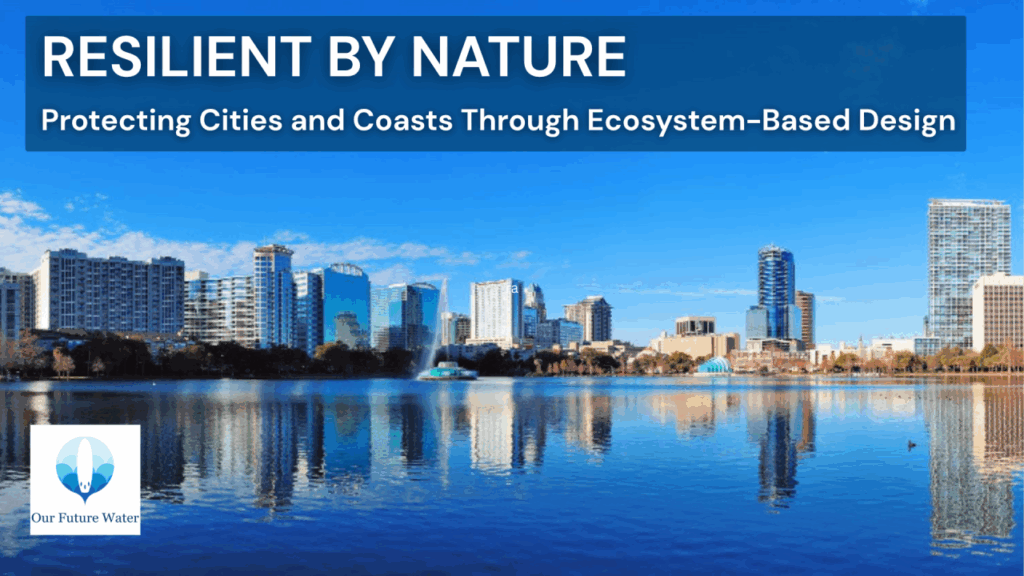
Nature-Based Solutions for Urban Coastal Resilience
Urban coastal areas are becoming increasingly vulnerable to rising sea levels, stronger storms, and erosion, necessitating the development of innovative and sustainable protection strategies. NBS harnesses the power of ecosystems, such as mangroves, wetlands, dunes, and reefs, to absorb wave energy, mitigate storm impacts, and reduce reliance on hard infrastructure like seawalls. These natural defenses not only protect cities but also enhance water quality, provide habitats, and sequester carbon.
Integrating NBS into coastal planning requires aligning environmental restoration with urban development policies and strategies. By integrating ecosystem-based design into zoning, land-use, and disaster management frameworks, cities can strike a balance between growth and long-term climate resilience. Collaboration among governments, civil society, and the private sector is crucial to scaling up these initiatives and overcoming funding and technical barriers.
The Living Breakwaters project on Staten Island exemplifies coastal NBS in action. Developed after Superstorm Sandy through the Rebuild by Design competition, this $107 million initiative utilizes 2,400 linear feet of ecologically enhanced breakwaters to mitigate wave impacts, mitigate erosion, and restore marine habitats. Its partnership with the Billion Oyster Project introduces live oyster reefs that enhance biodiversity and strengthen natural barriers. Through community engagement and education, Living Breakwaters also fosters public awareness and stewardship for resilient coastal living.
Read the full article by Robert C. Brears to discover how NBS are reshaping coastal resilience by combining ecological protection with community empowerment.
Floodplain Restoration: Reducing Flood Risks and Enhancing Ecosystems
Floodplain restoration reconnects rivers to their natural systems, enabling water to flow across floodplains and slow down during heavy rains. This natural process reduces flood intensity and protects downstream communities from damage. As climate change increases extreme weather events, restoring floodplains is proving to be an essential NBS for managing water risks while restoring vital habitats.
Beyond flood control, restored floodplains enhance water quality, recharge groundwater, sequester carbon, and provide habitats for wildlife and recreational opportunities. Economically, they reduce dependence on costly flood infrastructure and promote tourism through access to scenic, restored landscapes.
The Floodplains by Design (FbD) grant program in Washington State demonstrates how strategic investment can deliver multiple co-benefits. Led by the Washington State Department of Ecology in collaboration with American Rivers and the Bonneville Environmental Foundation, FbD funds projects that restore natural floodplain functions while protecting communities. One project removed outdated levees to reconnect the river, reducing flood risks, enhancing salmon habitats, and improving water quality through natural filtration and infiltration. With funding of up to $10 million per project, FbD promotes cross-sector partnerships and shows how integrated planning can align flood protection with ecosystem restoration.
Read the full article by Robert C. Brears to learn how floodplain restoration is advancing resilience and biodiversity through collaborative, nature-based approaches.
Key Takeaways
NBS offers practical, multi-benefit strategies for managing the impacts of climate change. Coastal ecosystems, such as reefs and wetlands, safeguard cities from rising seas, while floodplain restoration reduces flood risks and revitalizes ecosystems. Together, these approaches show that working with nature is not only more sustainable but also more resilient, cost-effective, and adaptable for the urban future.
Newly Published: Circular Economy and Liveable Cities (Cambridge University Press)
The Circular Economy and Liveable Cities, edited by Robert C. Brears, Our Future Water, has been published. This essential guide delivers actionable strategies and best practices for implementing circular economy, climate resilience, and sustainability in urban environments, with global examples from leading cities like Tokyo, New York, and Singapore to help planners, policymakers, and researchers build liveable and sustainable cities for the future.
Coming Soon — 2nd Edition of Nature-Based Solutions to 21st Century Challenges (Routledge)
Fully revised and updated, the second edition of Nature-Based Solutions to 21st Century Challenges by Robert C. Brears offers a timely and systematic review of how working with nature can address today’s most pressing environmental and societal issues. Featuring new case studies from across the globe, expanded insights on public policy, AI, and community-led initiatives, this edition is essential reading for anyone shaping a sustainable future.
Stay Connected & Gain Exclusive Water Insights
🔹 Stay ahead in water innovation! 👉 Sign up for Our Future Water’s LinkedIn newsletter for expert insights and industry trends.
🔹 Want in-depth Middle East water insights? 👉 Subscribe to the Middle East Water Tech Brief for exclusive analysis on desalination, AI innovations, mega-projects, and climate-resilient water investments.
🔹 Join the movement! 🌍 Become a member of the Our Future Water Network and connect with global water leaders shaping the future.
🔹 Join the conversation in the following LinkedIn groups:
Urban Water Security, Our Future Water, Circular Water Economy, Blue-Green Infrastructure, Nature-Based Solutions, Climate Resilient Water Resources Management, Water Governance, Global Climate Solutions, Nature-Based Water Management
📚 Explore the Full Book Collection on Nature-Based Solutions (NBS)
Harness the power of nature to tackle today’s climate and development challenges. Curated by Our Future Water and Global Climate Solutions, this collection offers practical frameworks for embedding NBS into policy, planning, and implementation.
🌱 Strategies for integrating NBS into planning, finance, and ecosystem restoration
🌍 Approaches that enhance biodiversity, climate adaptation, and resilience
📘 Tools for applying NBS across sectors and governance systems
Click here to explore the complete collection.
📚 Shape the Future of Sustainability: Contribute to Springer Nature’s Landmark Publications
As Editor-in-Chief, Robert C. Brears invites experts, researchers, and practitioners to contribute to impactful and forward-thinking publications from Springer Nature. These comprehensive Handbooks and Encyclopedias explore Nature-Based Solutions, sustainable resource management, ecosystem well-being, and the global energy transition.
- Palgrave Handbook of Nature-Based Solutions
- Palgrave Encyclopedia of Sustainable Resources and Ecosystem Resilience
- Palgrave Handbook of Ecosystems and Human Well-Being
- Palgrave Handbook of Energy Transition and Renewable Energy
- Palgrave Handbook of Urban Climate and Disaster Resilience
- Palgrave Handbook of Social Transformations in Science, Innovation, and Education
📚 Shape the Future of Climate Resilience: Contribute to Palgrave’s Pivot Series
As Series Editor, Robert C. Brears invites experts to contribute to Palgrave Studies in Climate Resilient Societies, a leading Pivot series (25,000–50,000 words) exploring climate resilience, policy innovation, and sustainability strategies.
📩 For more details, visit: Seeking Authors — Palgrave Studies in Climate Resilient Societies