Executive Summary: Urban water resilience depends on managing coastal ecosystems, watersheds, stormwater infrastructure, and urban development as interconnected systems. Coastal ecosystems can provide protective infrastructure, while watershed assessment can guide where green infrastructure investment delivers the greatest system value. The strategic takeaway is that ecological functions become more effective resilience assets when they are integrated with spatial planning, investment prioritization, monitoring, and adaptive management.
In simple terms: Cities can strengthen water resilience by combining nature-based infrastructure with systematic assessment, investment prioritization, and adaptive management.
This analysis reflects how utilities, planners, and public authorities structure urban water resilience to balance physical protection, ecological performance, and effective investment.
Urban resilience increasingly requires a systems approach connecting nature-based solutions with climate resilience planning across coastal zones, watersheds, and the built environment.
The Strategic Imperative
The strategic issue is how cities manage water-related risks that cross conventional infrastructure and administrative boundaries. Coastal erosion, storm-wave impacts, runoff, flooding, and declining water quality interact with land use, ecological conditions, and existing infrastructure. Managing each pressure independently can overlook opportunities for interventions to provide multiple functions. Coastal ecosystems can reduce physical exposure while supporting habitat and water quality, while watershed assessment can identify where green infrastructure offers the greatest combined value. This matters because resilience depends not only on individual projects, but also on the capacity of planning systems to understand interconnected risks, prioritize interventions, and adjust management as environmental and urban conditions change.
Integrating Ecological Functions with System Planning
Nature-based infrastructure and watershed assessment perform complementary functions within an integrated urban water strategy.
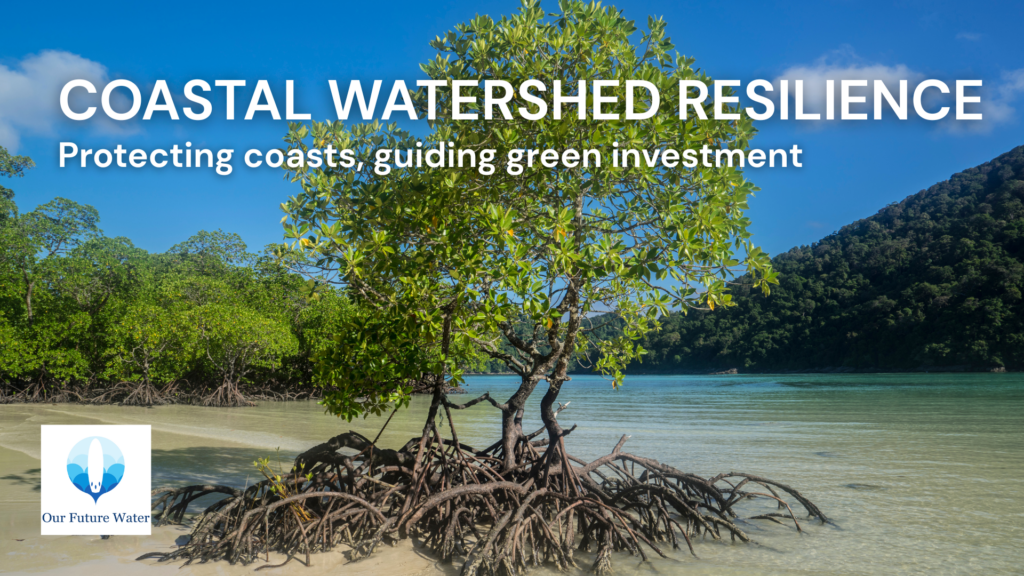
- Coastal protection: Mangroves, wetlands, dunes, reefs, and other natural barriers can absorb and dissipate wave energy, reducing storm impacts and shoreline erosion while complementing engineered defenses.
- Water regulation: Wetlands, vegetation, and green infrastructure can retain, filter, and manage water, helping moderate runoff pressures and improve water quality.
- Spatial assessment: Integrating land use, topography, climate, hydrology, and infrastructure data enables planners to identify locations where interventions can provide significant system benefits.
- Adaptive management: Monitoring performance allows authorities to refine priorities, redirect resources, and improve future interventions as watershed and coastal conditions evolve.
Key Insight: Ecological infrastructure delivers greater strategic value when its physical functions are connected to planning frameworks that determine where investment should occur, how projects are prioritized, and how performance is monitored over time.
Governance, Investment, and Implementation
The challenge is to convert ecological functions and watershed information into consistent infrastructure decisions. This requires governance arrangements that connect environmental objectives with land-use planning, stormwater management, disaster risk reduction, capital allocation, and project delivery. Multi-criteria prioritization can help authorities compare potential interventions across physical, environmental, social, economic, and implementation considerations rather than relying on a single performance measure. Monitoring then closes the management cycle by showing whether projects are delivering expected outcomes. When designed well, this approach positions nature-based infrastructure as part of a managed portfolio of resilience assets rather than as a separate environmental initiative.
| Dimension | Strategic Impact & Outcome |
|---|---|
| Resilience | Combines coastal protection, runoff management, filtration, habitat functions, and adaptive management to reduce exposure across interconnected urban water systems. |
| Governance | Links ecological processes with spatial planning, land-use regulation, project prioritization, monitoring, and disaster risk management. |
| Investment | Directs resources toward interventions capable of delivering multiple environmental, social, and infrastructure benefits through feasible implementation pathways. |
In practice, coastal resilience infrastructure and watershed assessment illustrate two sides of the same investment challenge. The first expands the range of assets available to manage water and climate pressures; the second strengthens the analytical framework used to decide where those assets should be deployed. Coastal ecosystems can complement engineered defenses while generating habitat, carbon, recreational, and educational benefits. Watershed assessment can use geospatial analysis and multi-criteria prioritization to identify green infrastructure opportunities and allocate resources. The wider implication is that infrastructure policy should connect project selection with system conditions, measurable co-benefits, implementation feasibility, and continuing performance monitoring.
Decision-Maker Application
- Assess the system: Integrate hydrology, topography, land use, climate, ecological conditions, and existing infrastructure to identify interconnected risks and intervention opportunities.
- Prioritize multiple benefits: Evaluate projects according to flood and erosion reduction, stormwater performance, water quality, ecological value, community benefits, and implementation feasibility.
- Monitor and adapt: Establish performance monitoring that allows investment priorities, management practices, and future projects to respond to observed outcomes and changing conditions.
Strategic Context
- Primary Focus: Integrated urban water resilience across coastal, watershed, and built systems.
- Core Mechanism: Combining nature-based infrastructure with watershed assessment, multi-criteria prioritization, monitoring, and adaptive management.
- Global Relevance: Cities facing flooding, erosion, stormwater, water-quality, and climate pressures need planning frameworks capable of directing limited resources toward interventions that provide multiple system benefits.
Conclusion
Urban water resilience is strengthened when ecological processes and structured decision-making operate as complementary infrastructure functions. Coastal ecosystems can provide physical protection alongside environmental and community benefits, while watershed assessment can determine where green infrastructure investment offers the greatest system value. The strategic priority is therefore not simply to expand nature-based interventions, but to integrate them into planning, governance, prioritization, and monitoring frameworks. By connecting ecological performance with infrastructure management and investment decisions, cities can build more adaptable approaches to flooding, erosion, stormwater, water quality, and long-term resilience.
Key Questions
What is urban water resilience?
Urban water resilience is a city’s ability to manage flooding, stormwater, erosion, water-quality pressures, and other water-related risks while maintaining essential infrastructure, ecosystems, and community functions.
How do nature-based solutions improve urban water resilience?
Nature-based solutions such as wetlands, mangroves, dunes, reefs, and green infrastructure can reduce flooding and erosion, regulate water flows, improve water quality, and complement engineered infrastructure.
Why is watershed planning important for cities?
Watershed planning helps cities understand how land use, hydrology, topography, climate, ecosystems, and infrastructure interact. This allows decision-makers to identify risks and prioritize interventions across the wider water system.
How can cities prioritize green infrastructure investment?
Cities can use geospatial analysis and multi-criteria assessment to compare potential projects based on flood reduction, water quality, ecological benefits, community value, cost, and implementation feasibility.
Can nature-based infrastructure replace engineered flood defenses?
Nature-based infrastructure does not always replace engineered defenses, but it can complement them. Combining ecological and engineered approaches can provide physical protection while delivering additional benefits such as habitat, recreation, water-quality improvement, and carbon capture.
What role does adaptive management play in urban water resilience?
Adaptive management connects infrastructure implementation with ongoing monitoring and evaluation. Cities can use performance data to adjust maintenance, investment priorities, and future interventions as climate risks, watershed conditions, and urban development change.